7 High-Growth Sectors Driving Additives Market Demand for Flame Retardants and Stabilizers
Modern plastics no longer compete on cost and processability alone. In electric vehicles, 5G infrastructure, data centers, renewable-energy systems, and high-performance electronics, polymers must combine flame resistance, thermal stability, UV resistance, oxidation resistance, and multi-year durability. This combination is only achievable with carefully engineered packages of flame retardants and polymer stabilizers.
As a result, additives market demand for these two families is accelerating. The central question for polymer engineers, compounders, additive suppliers, and OEMs is clear: which high-growth sectors are creating the strongest, most sustained demand, and what technical and regulatory factors will shape material selection through 2030 and beyond?
What Are Flame Retardants and Polymer Stabilizers?
Flame Retardants
Flame retardants reduce the flammability of polymers by interfering with one or more stages of the combustion cycle. Major classes include:
- Halogenated systems (primarily brominated)
- Halogen-free phosphorus-based systems
- Nitrogen-based systems
- Mineral flame retardants (aluminum hydroxide / ATH, magnesium hydroxide / MDH)
- Intumescent systems
- Reactive flame retardants that become chemically bound to the polymer
Basic mechanisms:
- Gas-phase radical quenching (typical of many halogenated systems)
- Condensed-phase char formation and barrier effects (phosphorus, intumescent, some mineral systems)
- Endothermic heat absorption and dilution of combustible gases (metal hydroxides)
- Physical dilution and oxygen exclusion
Polymer Stabilizers
Stabilizers protect polymers during high-temperature processing and throughout service life. Key categories include:
- Primary antioxidants (hindered phenols) that interrupt radical chain reactions
- Secondary antioxidants (phosphites, thioesters) that decompose hydroperoxides
- UV absorbers that filter damaging wavelengths
- Hindered amine light stabilizers (HALS) that scavenge radicals generated by UV exposure
- Heat stabilizers (especially important for PVC and high-temperature engineering polymers)
- Processing stabilizers that protect melt during extrusion and injection molding
Without effective stabilization, polymers lose molecular weight, embrittle, discolor, or fail mechanically long before their design life.
Why Is Additives Market Demand Increasing?
Several concurrent trends are raising both the volume and the performance requirements of flame retardants and stabilizers:
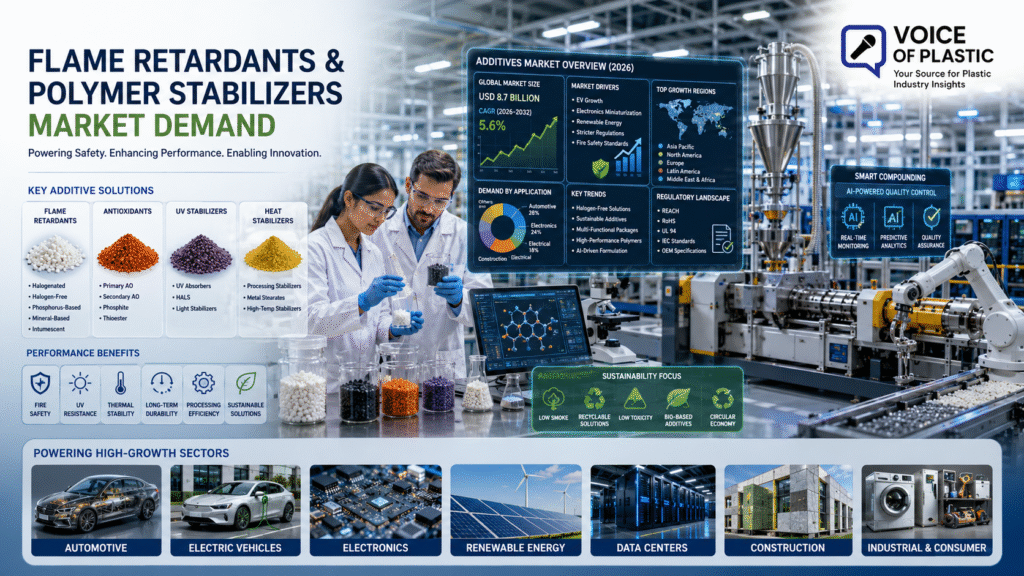
- EV growth – Battery housings, high-voltage connectors, busbars, charging components, and thermal-management parts operate at elevated temperatures and carry fire-safety risks.
- Electronics miniaturization – Higher power density and operating temperatures demand better thermal and oxidative stability plus reliable UL 94 performance in thinner walls.
- 5G and communication infrastructure – Dense RF and power electronics require low-smoke, halogen-free compounds with excellent electrical properties.
- Renewable energy – Solar, wind, and energy-storage systems expose polymers to outdoor UV, heat cycling, and electrical loads.
- Data centers and AI infrastructure – High electrical loads, dense cabling, and continuous operation raise fire-safety and thermal-aging requirements.
- Construction – Stricter building codes continue to drive flame-retardant cables, insulation, and structural plastics.
These drivers act simultaneously on both flame-retardant and stabilizer demand.
7 High-Growth Sectors Driving Demand
| Sector | Main Plastic Applications | Required Additives | Growth Driver |
|---|---|---|---|
| Automotive (ICE + hybrid) | Connectors, sensors, lighting, under-hood parts, interior electronics | FR (halogenated & halogen-free), antioxidants, heat stabilizers, UV/HALS | Lightweighting + higher under-hood temperatures |
| Electric Vehicles | Battery housings, HV connectors, busbars, charging systems, thermal management | High-performance FR (often halogen-free), antioxidants, heat stabilizers, specialized packages | Electrification + thermal-runaway concerns |
| Electrical & Electronics | Housings, connectors, circuit protection, switchgear, PCB-related polymers | UL 94 V-0 FR, antioxidants, processing stabilizers | Miniaturization + power density |
| Renewable Energy | Solar components, wind-turbine electrical systems, energy-storage housings | UV stabilizers, HALS, FR, antioxidants | Outdoor durability + fire safety |
| Data Centers & AI Infrastructure | Cable insulation, connectors, power-distribution components, enclosures | Low-smoke FR, heat stabilizers, antioxidants | High electrical loads + continuous operation |
| Construction | Cables, insulation, building components, profiles | FR (often mineral or phosphorus), UV/heat stabilizers | Building codes + fire safety |
| Consumer & Industrial Products | Appliances, power tools, outdoor equipment | FR, UV stabilizers, antioxidants | Safety standards + longer service life |
Automotive and EV Opportunity
Key polymers include PA6, PA66, PBT, PC, PC/ABS, PPS, PPA, PP, and various TPEs. Critical applications requiring both flame retardancy and stabilization include high-voltage connectors, battery-module components, charging-system housings, sensor housings, ECU enclosures, lighting, and cable systems.
Performance requirements frequently reference UL 94 ratings, glow-wire ignition temperature / glow-wire flammability index, comparative tracking index (CTI), thermal-aging performance, and UV resistance. Additive packages must be application-specific; a single formulation rarely satisfies every component.
Electrical & Electronics
Demand is driven by smartphones, consumer electronics, industrial controls, semiconductor equipment, connectors, switchgear, and power electronics. UL 94 V-0 remains the most commonly specified flammability rating for many housings and connectors, while V-1 and V-2 appear in less critical applications. Flame-retardant compounds must also maintain electrical insulation properties and processability in thin-wall parts.
Types of Flame Retardants Gaining Attention
| Technology | Advantages | Limitations | Typical Applications |
|---|---|---|---|
| Halogenated (brominated) | High efficiency at relatively low loading | Regulatory pressure, smoke toxicity concerns in some regions | Electronics, some automotive |
| Phosphorus-based | Good char formation, often halogen-free | Can affect mechanical properties or color | Engineering plastics, EVs, electronics |
| Metal hydroxides (ATH, MDH) | Low cost, endothermic, non-toxic | High loading required, impact on flow & mechanics | Cables, construction, some electronics |
| Intumescent | Excellent barrier formation | Processing sensitivity, cost | Construction, some industrial |
| Nitrogen-based | Synergistic with phosphorus, low smoke | Limited standalone efficiency | Engineering plastics |
| Mineral systems | Cost-effective, good for certain polymers | High loading | Wire & cable, construction |
| Reactive FR | Chemically bound, reduced migration | Formulation complexity | Specialty engineering polymers |
Industry movement toward halogen-free and lower-emission solutions is clear in electronics, EVs, and many European specifications, yet halogenated systems retain performance and cost advantages in selected applications. Selection remains polymer-, application-, and geography-dependent.
Stabilizer Market Opportunity
- Antioxidants protect against thermo-oxidative degradation during processing and long-term heat exposure.
- UV absorbers and HALS are essential for outdoor automotive parts, agricultural films, construction profiles, and renewable-energy components.
- Heat stabilizers are critical for PVC and high-temperature engineering polymers.
Longer design lives and higher continuous-use temperatures increase the need for sophisticated, synergistic stabilizer packages rather than single-component solutions.
Regulations and Market Pressure
Additive selection is governed by the combination of polymer, application, temperature, fire requirement, electrical requirement, geography, and OEM specification. Relevant frameworks include REACH, RoHS, UL 94, various IEC standards, automotive OEM material specifications, and regional chemical restrictions. No single regulation applies universally; formulators must map requirements case by case.
Market Data and Forecast
Market estimates vary by scope, methodology, and inclusion of related chemistries. Representative recent figures include:
Flame retardants
- Grand View Research: ~USD 10.6 billion in 2025, projected to reach ~USD 18.1 billion by 2033 (CAGR 6.9% from 2026–2033).
- Global Market Insights: ~USD 9.8 billion in 2025, growing to ~USD 17.7 billion by 2035 (CAGR 6.1% from 2026–2035).
- IMARC: ~USD 11.0 billion in 2025, projected to ~USD 17.4 billion by 2034 (CAGR 5.12%).
- Other reports show 2024–2025 values in the USD 7–11 billion range with CAGRs typically 5–7%.
Asia-Pacific is consistently the largest regional market, driven by electronics and construction. Electrical & electronics is frequently the leading end-use segment.
Polymer stabilizers Recent estimates place the market in the approximate range of USD 6.7–11 billion in 2024–2025, with projected CAGRs generally between 3.8% and 7.8% depending on scope and forecast horizon, reaching roughly USD 9–21 billion by the early-to-mid 2030s according to different sources.
Overall plastic additives markets are larger (tens of billions of USD), with flame retardants and stabilizers forming important high-value segments.
Differences in reported sizes arise from inclusion/exclusion of specific chemistries, captive production, regional coverage, and whether figures are value or volume based. Forecasts should be treated as directional rather than precise predictions.
| Metric | Current Position (approx.) | Forecast | Key Driver |
|---|---|---|---|
| Flame retardants global | USD 9.8–11 bn (2025) | USD 17–18 bn by early 2030s | E&E, EVs, construction, regulations |
| Polymer stabilizers global | USD 7–11 bn range (2024–25) | Continued mid-single to high-single digit CAGR | Automotive, packaging, outdoor durability |
| Halogen-free FR growth | Faster than overall FR market | Strong CAGR through 2030s | Regulatory pressure + EV/electronics specs |
Regional Demand
- Asia-Pacific (China, India, Japan, South Korea) leads in volume due to electronics manufacturing, EV production, and infrastructure.
- North America shows strong demand from EVs, data centers, electronics, and infrastructure investment.
- Europe emphasizes sustainability, chemical regulation, automotive, and renewable energy, accelerating halogen-free and lower-toxicity solutions.
Key Market Challenges
High additive loadings can reduce impact strength, tensile properties, flow, surface appearance, and sometimes electrical performance. Additional issues include cost, regulatory complexity, material compatibility, blooming/migration, color limitations, recyclability, thermal stability of the additive package itself, and supply-chain risks. Successful formulations balance fire performance or stability against these trade-offs.
Future Trends
- Continued growth of halogen-free flame retardants
- Reactive and polymeric flame retardants
- Low-smoke and low-toxicity formulations
- Multifunctional additive packages
- Bio-based and more sustainable stabilizer chemistries
- Nano-enabled systems (still largely developmental)
- High-performance compounds for engineering polymers
- AI-assisted formulation and computational materials approaches
- Improved compatibility with recycling streams
AI and computational tools are beginning to accelerate screening of additive combinations and prediction of long-term aging behavior, potentially shortening development cycles.
Strategic Opportunities for Manufacturers
Additive manufacturers: Develop application-specific packages for EVs and electronics; improve sustainability profiles; expand halogen-free and multifunctional offerings.
Compounders: Optimize loading levels to preserve mechanical properties; validate fire and aging performance rigorously; improve processability.
OEMs: Define additive and performance requirements early in design; evaluate full lifecycle and regulatory compliance; validate long-term thermal and UV aging under realistic conditions.
2026–2035 Outlook (Strategic)
- 2026–2027: Strong demand growth from EVs, electronics, data centers, and renewables.
- 2028–2030: Wider adoption of halogen-free and multifunctional systems; tighter regulatory influence.
- 2030–2035: Increased use of smart formulation tools, circularity considerations, and advanced high-performance compounds.
This is a strategic outlook based on current drivers, not a guaranteed forecast.
Conclusion
Additives market demand for flame retardants and polymer stabilizers is being driven by the simultaneous need for fire safety, thermal stability, UV resistance, and long-term durability in high-growth sectors—especially electric vehicles, electrical & electronics, data centers, renewable energy, and construction. Flame retardants remain essential for meeting safety standards, while stabilizer packages are becoming more sophisticated to support higher temperatures and longer service lives. Sustainable and application-specific chemistry will increasingly differentiate suppliers. The industry is moving from commodity additive packages toward tailored, high-performance, regulatory-compliant systems that enable the next generation of advanced plastics.
SEO FAQ Section
What is driving demand for flame retardants? Stricter fire-safety regulations, growth in EVs, electronics, data centers, construction, and renewable energy are the main drivers. Higher power densities and operating temperatures further increase the need for reliable flame-retardant polymer compounds.
What are polymer stabilizers? Polymer stabilizers (antioxidants, UV absorbers, HALS, heat stabilizers) protect plastics from degradation during processing and service life caused by heat, oxygen, UV light, and mechanical stress, preserving properties over time.
Why are flame retardants important in EVs? EV battery systems, high-voltage connectors, charging components, and thermal-management parts carry elevated fire risks. Flame-retardant polymers help meet safety standards and mitigate thermal-runaway propagation risks.
What are halogen-free flame retardants? Systems based primarily on phosphorus, nitrogen, mineral (ATH/MDH), or intumescent chemistries that achieve flame retardancy without bromine or chlorine, often preferred where low smoke, lower toxicity, or regulatory compliance is prioritized.
What is the difference between flame retardants and stabilizers? Flame retardants reduce flammability and slow fire spread. Stabilizers protect the polymer against thermal, oxidative, and UV degradation during processing and use. Both are frequently required together in high-performance applications.
Which industries use the most polymer additives? Electrical & electronics, automotive/EV, construction, wire & cable, and packaging are major consumers. Flame retardants are especially concentrated in E&E and construction; stabilizers are used more broadly.
Why are stabilizers important in automotive plastics? Under-hood and exterior parts experience high heat, UV exposure, and long service lives. Antioxidants, heat stabilizers, and UV/HALS systems prevent embrittlement, discoloration, and mechanical failure.
What is UL 94 V-0? A flammability rating indicating that a vertical specimen extinguishes within 10 seconds after two flame applications and does not produce flaming drips that ignite cotton. It is widely specified for electronic housings and connectors.
Are halogen-free flame retardants the future? They are growing faster than the overall market in many regulated and high-visibility applications (electronics, EVs, Europe), but halogenated systems retain advantages in efficiency and cost for certain uses. Both will coexist for the foreseeable future.
How are regulations affecting plastic additive demand? REACH, RoHS, building codes, OEM specifications, and regional chemical restrictions influence which chemistries are preferred or restricted, accelerating demand for compliant halogen-free and lower-toxicity solutions in many markets.
What is the future of the flame retardant market? Continued growth driven by electrification, electronics, and safety regulations, with a shift toward halogen-free, low-smoke, and multifunctional systems alongside ongoing use of high-efficiency traditional chemistries where appropriate.
How is AI changing polymer additive development? AI and computational materials science are being used to screen formulations, predict aging behavior, and optimize additive packages more rapidly, potentially reducing development time and improving performance–cost balances.