Advanced Thermoplastics for EV Battery Enclosures: Material Selection Guide for OEMs
The global electric vehicle (EV) market is entering a phase of exponential growth and technological maturation. According to the International Energy Agency (IEA), electric car sales exceeded 10 million in 2022, and this trajectory is accelerating rapidly towards 2030. For Automotive Original Equipment Manufacturers (OEMs) and Tier-1 suppliers, this shift places unprecedented pressure on the heart of the EV: the battery system.
Historically, steel and aluminum have dominated EV battery enclosure materials. However, as OEMs strive for greater range, improved energy efficiency (kWh/mile), and reduced vehicle weight, metals are reaching their physical and economic limits. The imperative for EV lightweight design is absolute; every kilogram saved in the battery housing allows for more cells or increased range, directly impacting consumer adoption and regulatory compliance.
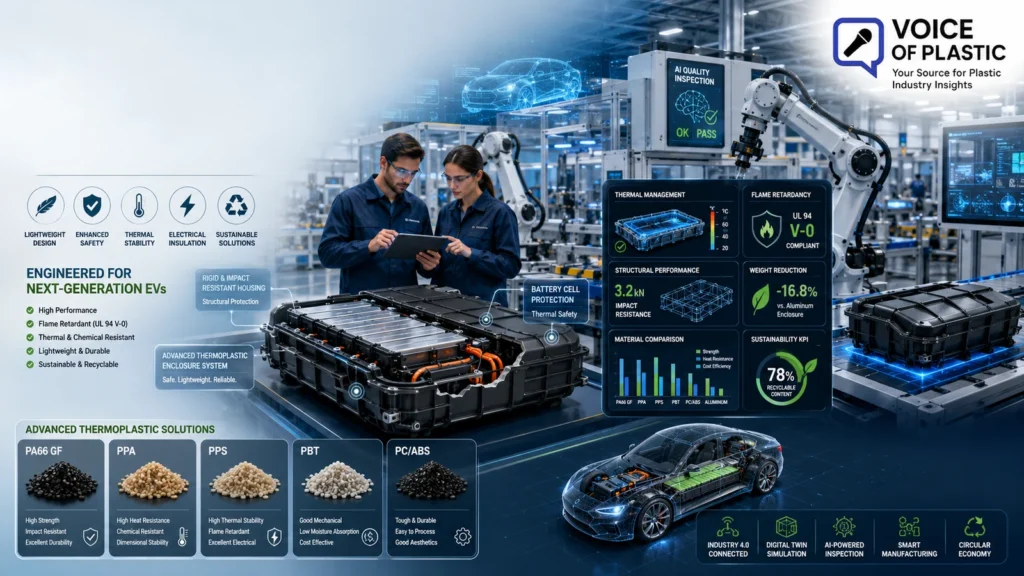
The solution lies in advanced engineering thermoplastics. These high-performance polymers offer a convergence of lightweighting, design freedom, functional integration, and inherent safety characteristics that metals cannot match. In this comprehensive guide, we analyze the critical role of thermoplastics for EV battery enclosures, comparing material properties, manufacturing technologies, and strategic frameworks to assist OEMs in making data-driven material selection decisions for the 2025–2030 vehicle platforms.
What Is an EV Battery Enclosure? Its Crucial Role in the Vehicle Architecture
The EV battery enclosure, often referred to as the battery pack housing or tray, is far more than a simple storage box. It is a critical structural and safety component of the vehicle architecture. Its functions include:
Environmental Protection: Sealing sensitive cells, electronics, and the Battery Management System (BMS) from moisture, dust, salt, and automotive fluids.
Structural Integrity: Acting as a stressed member of the vehicle chassis, particularly in “cell-to-chassis” or “cell-to-pack” configurations, managing torsional stiffness and dynamic loads.
Crash Performance: Protecting the battery cells during side-impact, frontal collision, and underbody intrusion events. The material must absorb and redirect massive amounts of energy.
Thermal Management: Facilitating the dissipation of heat generated during rapid charging and discharging, while providing insulation to maintain optimal cell temperatures.
Electrical Insulation: Inherently isolating high-voltage components from the vehicle chassis, crucial for passenger safety.
Safety Barrier: Acting as the primary line of defense against thermal runaway events, preventing external fire penetration and containing internal failures.
As battery pack voltages rise to 800V and beyond, and energy densities increase, the requirements for the electric vehicle battery housing have become exceptionally stringent.
Critical Material Requirements for Next-Generation Enclosures
Selecting the right battery pack materials requires balancing complex, and often conflicting, engineering performance criteria.
1. Flame Retardancy and Thermal Runaway Protection
Safety is paramount. Material selection is dominated by flame retardancy (FR). While UL 94 V-0 is the baseline requirement, next-generation enclosures must withstand extreme thermal runaway scenarios, where localized temperatures can exceed 1000°C. Flame retardant thermoplastics must possess high Relative Thermal Indices (RTI) and often include intumescent (char-forming) additives to maintain structural integrity and delay fire penetration into the passenger cabin.
2. Lightweight Engineering
The primary driver for shifting from metals to polymers. Advanced automotive thermoplastics offer density reductions of 15% to 50% compared to aluminum, contributing directly to EV range improvement and overall energy efficiency.
3. Mechanical Strength and Impact Resistance
The enclosure must support the immense weight of the cells (often 500kg+) and survive dynamic road loads, stone impacts, and crash scenarios. High-modulus and high-impact grades of engineering thermoplastics, typically reinforced with glass or carbon fibers, are required.
4. Chemical Resistance and Environmental Stability
The battery pack is exposed to harsh conditions, including road de-icing salts, automotive fluids (coolants, brake fluid, transmission fluid), and extreme temperature fluctuations. The selected polymer must resist hydrolysis, chemical degradation, and maintain dimensional stability over the vehicle’s 15+ year lifespan.
5. Thermal Management Capabilities
While polymers are inherently insulative, materials used in thermal management components (like cooling plates or cell spacers) may require enhanced thermal conductivity through specialized fillers to assist in heat dissipation. Conversely, the outer cover needs excellent thermal insulation to protect against external fire sources.
6. Electromagnetic Interference (EMI) Shielding
With high-voltage switching and sensitive BMS electronics in close proximity, protecting against EMI/RFI is critical. While inherently transparent to EMI, certain battery enclosure plastics can be made conductive or shielded via secondary coatings, metal inserts, or conductive fillers.
Advanced Thermoplastics Used in EV Battery Enclosures
The “one-size-fits-all” approach to material selection is obsolete. The diverse components within a battery pack—trays, covers, module housings, busbar covers, and spacers—require distinct polymer solutions.
1. Polyamides (PA6, PA66) – The Workhorse
Glass-fiber reinforced Polyamide 6 (PA6-GF) and Polyamide 66 (PA66-GF) are the current dominant engineering thermoplastics in automotive under-the-hood applications and are increasingly used for battery modules and structural enclosures.
Pros: Excellent balance of cost, mechanical strength, processability, and heat resistance. Good chemical resistance to oils and coolants.
Cons: Hygroscopic nature (absorbs moisture), which can impact dimensional stability and mechanical properties post-conditioning.
Key Application: Polyamide battery enclosure covers, module frames, cell holders.
2. Polybutylene Terephthalate (PBT)
PBT is favored for components requiring precise dimensional stability and electrical insulation in demanding environments.
Pros: Excellent electrical properties (dielectric strength), low moisture absorption, high dimensional stability, and good chemical resistance.
Cons: Lower impact strength compared to PA6/PA66.
Key Application: Busbar holders, connectors, high-voltage component housings, PBT battery housing covers.
3. Polyphenylene Sulfide (PPS)
PPS is a high-performance semi-crystalline polymer used when extreme heat and chemical resistance are mandatory.
Pros: Inherent flame retardancy (without additives), exceptional thermal stability (RTI up to 240°C), outstanding chemical resistance, and excellent dimensional stability.
Cons: Higher cost, brittle nature (requires reinforcement), and more challenging processing.
Key Application: Critical safety components, battery cell-to-pack structural members requiring high-heat performance, thermal runaway barriers.
4. Polycarbonate / Acrylonitrile Butadiene Styrene (PC/ABS) Blends
PC/ABS blends combine the impact resistance and heat resistance of PC with the processability of ABS.
Pros: Excellent low-temperature impact strength, good dimensional stability, good aesthetics (for visible components), and easy processing.
Cons: Limited chemical resistance to certain automotive fluids; lower continuous service temperature than polyamides.
Key Application: Battery pack covers (upper), side reinforcement panels, where impact is a primary concern.
5. Polyphthalamide (PPA)
PPA is a high-performance polyamide that bridges the gap between standard engineering thermoplastics (like PA66) and specialty polymers (like PPS).
Pros: Lower moisture absorption and higher mechanical properties at elevated temperatures than PA66. Excellent dimensional stability and chemical resistance.
Cons: Higher cost than standard polyamides.
Key Application: Connectors, structure-critical module components, thermal management interfaces.
6. Polypropylene Long Glass Fiber (PP-LGF)
PP-LGF is a cost-effective, lightweight alternative for larger structural parts with moderate thermal requirements.
Pros: Very low density (lightest common option), excellent chemical resistance, low moisture absorption, and good processability via compression or injection molding.
Cons: Lower continuous service temperature (limit around 100-120°C) and lower flame retardancy performance compared to engineered nylons or PBT.
Key Application: Large underbody battery trays (where extreme heat isn’t primary), battery pack structural covers.
Table 1: Comparative Analysis of Key Engineering Thermoplastics for EV Battery Enclosures
| Property (Reinforced Grades) | PA66-GF30 | PPA-GF35 | PBT-GF30 | PPS-GF40 | PC/ABS (FR) | PP-LGF40 |
| Density (g/cm³) | 1.35-1.40 | 1.45-1.50 | 1.50-1.55 | 1.65-1.70 | 1.15-1.25 | 1.20-1.25 |
| Tensile Strength (MPa) | 160-190 | 200-240 | 120-140 | 150-180 | 60-80 | 110-130 |
| Flexural Modulus (GPa) | 9.0-11.0 | 12.0-15.0 | 9.0-10.0 | 14.0-16.0 | 2.5-3.5 | 8.0-10.0 |
| Heat Deflection Temp (HDT @ 1.8MPa) | 240-255°C | 270-290°C | 200-215°C | >270°C | 100-120°C | 150-160°C |
| Relative Thermal Index (RTI Elec, °C) | 130-140 | 140-150 | 130-140 | 200-240 | 80-90 | 105-115 |
| Moisture Absorption (%) | High (1.5-2.5) | Low (0.2-0.4) | Very Low (<0.1) | Very Low (<0.1) | Low (0.2) | Very Low (<0.1) |
| Chemical Resistance | Good (Oils) | Excellent | Very Good | Outstanding | Moderate | Outstanding |
| Baseline Flame Rating (UL 94) | V-0 (FR grades) | V-0 (FR grades) | V-0 (FR grades) | V-0 (Inherent) | V-0 (FR grades) | HB (V-0 specialized) |
| Relative Cost | Medium | Medium-High | Medium | High | Medium | Low |
(Note: Data is representative of typical commercial glass-fiber reinforced grades; properties vary significantly by formulation and additive package).
Strategic Comparison: Thermoplastics vs. Metals
The transition to thermoplastics is a strategic decision centered on the Total Cost of Ownership (TCO) and vehicle-level performance optimization.
1. Weight Reduction and Range
This is the single most compelling factor. Lightweight EV materials like PP-LGF and PC/ABS can offer a 30-50% weight reduction compared to aluminum for the upper battery cover. Reducing the pack weight enables:
Increased energy density at the vehicle level.
Extended driving range.
Downgrading of suspension and braking components, creating a secondary weight-saving loop.
2. Functional Integration and Manufacturing Efficiency
Metal enclosures require extensive stamping, welding, riveting, and sealing of multiple components. In contrast, injection molding allows for complex, near-net-shape geometries. OEMs can integrate:
Cooling channels (via fluid injection molding or vibration welding).
Mounting brackets, snap-fits, and bosses.
Seal grooves and gasket interfaces.
EMI shielding grids.
This functional integration reduces the Bill of Materials (BOM) count, simplifies assembly, eliminates secondary operations, and reduces production time.
3. Electrical Insulation
Metals are inherently conductive and require separate insulating coatings or films to protect against high-voltage short circuits. Thermoplastics are excellent electrical insulators (dielectric strength typically 15-30 kV/mm), providing an inherent safety layer and simplifying the electrical architecture.
4. Corrosion Resistance
EV battery packs are subject to extreme environmental corrosion. Aluminum requires chemical conversion coatings and paint. Engineering plastics are inherently resistant to road salt, coolants, and environmental moisture, ensuring long-term durability without expensive coatings.
Table 2: Thermoplastics vs. Metals: Head-to-Head Comparison for EV Battery Housings
| Consideration | Engineering Thermoplastics | Aluminum (6000/7000 Series) | Steel (High-Strength) |
| Density (g/cm³) | 1.2–1.7 | ~2.7 | ~7.8 |
| Weight Potential | Lowest | Moderate | High (Heavy) |
| Specific Strength | Very High | High | Moderate |
| Manufacturing Method | Injection/Compression Molding | Stamping, Extrusion, Casting | Stamping, Roll Forming |
| Complexity Potential | High (Functional Integration) | Low (Assembly of parts) | Low (Assembly of parts) |
| Electrical Conductivity | Insulative (Inherent) | Conductive (Requires insulation) | Conductive (Requires insulation) |
| Corrosion Resistance | Excellent (Inherent) | Good (Requires treatment) | Poor (Requires treatment) |
| Thermal Conductivity | Low (Insulative) | High | Moderate |
| Impact Performance | Good (Energy absorption/ductility) | High (Plastic deformation) | Very High (Stiffness) |
| Flame Retardancy | Requires FR Additives | Non-combustible (but melts at ~660°C) | Non-combustible (high melt point) |
| Total Cost of Ownership | Low (at high volume) | Medium-High | Low-Medium |
| Sustainability | Recyclable (Mechanical/Chemical) | High (Infinitely recyclable) | High (Infinitely recyclable) |
Advanced Manufacturing Technologies for Thermoplastic Enclosures
The maturity of the molding process is as critical as the material itself.
1. Injection Molding
The predominant method for components requiring complex geometries, high dimensional precision, and functional integration. Advanced techniques include:
Large-Tonnage Injection Molding: Utilizing 3,000 to 5,000+ ton machines to mold entire battery covers.
Insert Molding: Molding the plastic around metal threaded inserts, cooling tubes, or busbars.
Overmolding: Molding a soft elastomer seal directly onto a rigid thermoplastic cover, eliminating separate gaskets.
MuCell® (Microcellular Foaming): Injecting inert gas during molding to create a microcellular structure, reducing part weight by 10-20% and improving dimensional stability, though often with a slight reduction in mechanical strength.
2. Compression Molding of Organosheets / DFT
For larger structural trays requiring extreme strength and crash performance, compression molding of Thermoplastic Composites (TPC) is used.
Organosheets: Consist of woven carbon or glass fibers pre-impregnated with a thermoplastic matrix (e.g., PA6, PP). These are heated and compression-molded into highly structural parts.
Direct Filament Transmission (DFT): Similar to organosheets, this process uses continuous fiber reinforcement tailored exactly to the load paths required in the part.
3. Hybrid Molding
Combining the benefits of both worlds: stamping a continuous fiber-reinforced organosheet preform and immediately overmolding it with chopped-fiber thermoplastic to add complex features like ribs, bosses, and connectors in a single cycle.
4. Joining Technologies
Joining large thermoplastic components necessitates advanced welding processes, replacing traditional fasteners:
Laser Welding: High-precision joining, ideal for sealing covers.
Vibration Welding: Well-suited for large, complex parts like cooling manifolds.
Infrared (IR) Welding: Non-contact heating method that minimizes flash and particle generation.
Table 3: Overview of Manufacturing Methods for Thermoplastic Battery Components
| Technology | Preferred Materials | Typical Components | Pros | Cons |
| Injection Molding | PA, PBT, PPS, PC/ABS, PP-GF | Module housings, busbar covers, connectors | High precision, complex shapes, fast cycle | High tooling cost, limited size |
| Compression Molding | PP-LGF, PA-LGF | Large trays, structural bottom covers | Large parts, low cost molding machines | Lower precision, slower cycle |
| Organosheet Molding | PA-GF Continuous, PP-GF Continuous | Structural underbody trays, impact beams | Extreme strength, crash resistance | High material cost, complex process |
| Hybrid Molding | PA-GF Continuous + PA-GF Inj. | Stiffened covers, integrated structures | Best strength/complexity balance | Highest complexity and tooling cost |
The OEM Material Selection Framework: A 6-Step Decision Matrix
Material scientists and CAE engineers must utilize a structured decision-making process to balance performance, cost, and risk.
1. Define Environmental and Thermal Baseline
What is the continuous service temperature? The battery thermal management strategy (air-cooled vs. liquid-cooled) dictates the thermal environment. Is the component inside the pack or exterior?
2. Assess Flame Retardancy and Safety Requirements
Baseline must be UL 94 V-0. Crucially, define the required duration of thermal runaway resistance. A polymer battery housing for a luxury EV might require PPS or intumescent PPA to provide a 5-minute passenger exit window, while a smaller city car may utilize a high-performance PC/ABS.
3. Determine Mechanical and Structural Loads
Use FEA simulation to model static loads (battery weight), dynamic loads (road vibration), and crash events (impact, side crushing). This dictates the modulus (stiffness) required and the level of glass/carbon fiber reinforcement (e.g., 30%, 40%, 50%+).
4. Evaluate Chemical and Fluid Exposure
Will the material encounter transmission fluid, brake fluid, coolant (hydrolysis resistance for PA), or road salts? This is critical for chemical resistance plastics selection.
5. Manufacturing Scalability and Cost
For high-volume programs (100k+ units/year), injection molding is crucial for low cycle times. At lower volumes, compression molding of PP-LGF might offer lower tooling and investment costs.
6. Sustainability and Circular Economy
Meet corporate sustainability goals. The selected thermoplastic must be recyclable. Evaluate bio-based engineering plastics (e.g., Bio-PA derived from castor oil) or grades with post-industrial/post-consumer recycled (PCR) content.
2025–2026 Industry Case Study: Reducing Weight and Enhancing Safety
The Scenario
A leading global EV OEM aimed to replace the aluminum upper cover of its flagship mid-size SUV battery pack (800V system) for the 2026 model year.
The Challenge
Weight: Reduce part weight by 20% compared to the 8.5 kg aluminum design.
Safety: Must meet UL 94 V-0 at 1.5mm and withstand a simulated localized thermal runaway event at 800°C for at least 3 minutes.
Dimensional Stability: Maintain tighter flatness tolerances than aluminum post-molding for a critical perimeter seal.
Volume: 150,000 units per year.
The Material Solution
After FEA simulation and material indexing, the team selected a 35% glass-fiber reinforced, halogen-free flame-retardant Polyphthalamide (PPA-GF35 FR).
Why PPA? PPA offered significantly lower moisture absorption and superior high-temperature stiffness than PA66-GF. PPA-GF35 was critical for satisfying the dimensional stability requirements across the temperature range (-40°C to 120°C). The specific FR package facilitated char formation during thermal runaway testing.
The Manufacturing Process
A 4,000-ton large-scale injection molding machine was employed. The design utilized overmolding technology to integrate the main thermoplastic cover with a soft silicone perimeter seal and molded-in stainless steel compression limiters for bolt attachments.
The Results
Weight Reduction: The final PPA part weight was 6.1 kg, a 28% weight reduction compared to the 8.5 kg aluminum assembly.
Safety Validation: The PPA-GF35 FR successfully formed a robust insulating char layer during the thermal runaway simulation, preventing penetration for 4 minutes, exceeding the OEM specification.
Total Cost of Ownership: Although the PPA material cost per kilogram was higher than aluminum, the elimination of extensive sealing, secondary machining, coating, and reduced assembly steps resulted in a 5% reduction in total part cost at 150,000 units.
Dimensional Stability: Excellent, meeting the perimeter flatness tolerance of <1.5mm across the 2-meter part length.
Future Trends: 2025–2035 Horizon
The future of EV materials is defined by sustainability, digital twins, and fundamental innovations in polymer chemistry.
1. Carbon Fiber Reinforced Thermoplastics (CFRTP)
While currently high-cost, continuous carbon fiber thermoplastics will increasingly enter premium EV segments. CFRTP offers aluminum-like stiffness at polymer density, making them ideal for critical structural members in “cell-to-chassis” packs. Hybrid molding processes will decrease cycle times, enabling wider adoption.
2. Bio-Based and Recycled Engineering Plastics
OEMs are setting ambitious carbon-neutral goals. The demand for engineering plastics with PCR content (especially derived from automotive shredder residue) will soar. We will also see increased use of high-performance bio-based engineering thermoplastics derived from non-food sources (e.g., castor beans, lignin) for structural parts like PBT battery housing.
3. Electrically and Thermally Conductive Polymers
As voltages increase, the line between insulation and thermal management blurs. We predict a rise in “smart” polymers—thermoplastics with specialized ceramic or metallic fillers that can offer engineered thermal conductivity pathways to assist cooling plates, or precisely tuned EMI shielding within the plastic itself.
4. Smart Manufacturing and AI-Assisted Material Selection
Material science will be integrated into Industry 4.0. OEMs will utilize machine learning and AI to analyze vast material property databases and FEA simulation results to discover optimized polymer formulations tailored precisely to specific vehicle platforms and battery architectures.
Best Practices for OEMs and Suppliers
Engage Early: Involve material suppliers at the earliest stage of concept design (Level 1/2) rather than Level 4/5 sourcing.
Move Beyond V-0: Specify materials based on their thermal runaway propagation resistance (TRP) and char-forming ability, not just the UL 94 V-0 baseline.
Validate Dimensional Stability Post-Conditioning: For hygroscopic materials like PA6/PA66, always validate mechanical properties and dimensional tolerances after moisture absorption to ensure real-world performance.
Embrace Functional Integration: Think beyond simple part replacement. Redesign the assembly to combine multiple metal parts into a single injection-molded component.
Utilize Advanced Joining: Optimize welding parameters (laser, vibration, IR) to ensure reliable hermetic seals, eliminating expensive chemical glues or extensive fasteners.
Evaluate TCO, Not Cost/kg: Consider the savings from eliminated secondary operations, painting, coatings, and simplified assembly when comparing thermoplastic prices to metals.
Prioritize Halogen-Free FR: Shift toward halogen-free flame retardants to meet increasing global environmental regulations and enhance corporate sustainability.
Design for Recyclability: In structural parts, utilize materials like PP-LGF or PBT that are more straightforward to recycle than thermosets or some complex high-heat polymers.
Partner with Converters: Establish long-term R&D partnerships with experienced molding converters (injection molding consultants) to ensure processing capabilities match the material specifications.
Implement Digital Twins: Use digital twins and FEA simulation for both the product and the molding process (mold flow analysis) to predict warp and minimize development cycles.
Common Material Selection Mistakes
Ignoring Hydrolysis in PA: Underestimating the impact of moisture on glass-fiber reinforced PA6/66, leading to dimensional instability and loss of stiffness over time.
Poor FR Selection for TRP: Assuming all UL 94 V-0 materials are equal during a thermal runaway. Low-char-forming polymers can fail rapidly under catastrophic heat flux.
Underestimating Creep: Failing to account for long-term creep (deformation under static load) of thermoplastic parts holding heavy battery modules, particularly at elevated temperatures.
Over-Engineering (and Cost): Specifying high-cost polymers like PPS when PPA or PBT would meet the performance requirements.
Focusing on Material Cost, Not Part Cost: Making decisions based solely on price per kilogram instead of analyzing the total manufacturing cost and lightweighting benefits (kWh range gain).
Conclusion
The shift from metals to advanced thermoplastics for EV battery enclosures is a prerequisite for next-generation electric mobility. The strategic move to polymers enables significant vehicle lightweighting, increased energy efficiency, enhanced crash safety, inherent electrical insulation, and superior design flexibility.
However, selecting the optimal material—be it a cost-effective PP-LGF, a dimensional stable PBT, or a high-heat performing PPS—requires a deep understanding of polymer science, manufacturing technologies, regulatory standards, and lifecycle economics.
By adopting a structured selection framework and engaging early with experienced material scientists and conversion specialists, automotive OEMs can navigate this complexity. OEMs that master advanced thermoplastic implementation will not only reduce BOM costs and accelerate production cycles but also deliver EVs that are fundamentally lighter, safer, and possess a competitive edge in range and consumer appeal. The future of electric vehicle architecture is plastic.
✅ Read more (Voice of Plastic – www.voiceofplastic.com)
- Health care plastic
- Plastic automotive trends in EV
- Emerging markets -Plastic manufacturing opportunies
- self healing polymer
- Barrier coating
- Pyrolysis recycling for mixed plastic
🌐 Authoritative References
1. International Flammability & Material Standards
UL Solutions
UL 94: Standard for Tests for Flammability of Plastic Materials for Parts in Devices and Appliances — Specifies vertical burn test criteria (V-0, 5VA, 5VB) required for EV battery polymer housings.
UL 2580: Standard for Batteries for Use in Electric Vehicles — Defines mechanical crush, environmental testing, and thermal runaway propagation standards for EV battery assemblies.
International Electrotechnical Commission (IEC)
IEC 60695-11-10: Fire Hazard Testing – Test Flames — Global harmonized fire safety test methods for plastic materials.
IEC 62660-3: Secondary Lithium-Ion Cells for Propulsion of Electric Road Vehicles — Safety and abuse testing standards for lithium-ion battery cells.
2. Vehicle Safety & Environmental Regulations
United Nations Economic Commission for Europe (UNECE)
UNECE Regulation No. 100 (ECE R100.03) — Mandatory European and global type approval standard for electric powertrain electrical safety and High-Voltage Rechargeable Energy Storage Systems (REESS).
International Organization for Standardization (ISO)
ISO 16750 Series: Road Vehicles – Environmental Conditions and Testing for Electrical and Electronic Equipment — Covers mechanical, thermal, climatic, and chemical load testing for automotive enclosures.
ISO 6469-3: Electrically Propelled Road Vehicles – Safety Specifications (Electrical Safety) — Defines protective barriers, insulation, and electrical shock protection standards for high-voltage battery systems.
SAE International
SAE J2464: Electric and Hybrid Electric Vehicle Rechargeable Energy Storage System (RESS) Safety and Abuse Testing — Guidelines for thermal, mechanical, and electrical abuse testing of battery packs.
SAE J2929: Electric and Hybrid Vehicle Propulsion Battery System Safety Standard — System-level safety metrics for lithium-based automotive batteries.
3. Market Intelligence & Global Energy Reports
International Energy Agency (IEA)
IEA Global EV Outlook & Data Explorer — Global market data, deployment statistics, and battery demand forecasts for electric vehicles.
U.S. Department of Energy (DOE)
DOE Vehicle Technologies Office – Battery R&D and Lightweighting Programs — Technical reports on EV battery enclosures, thermal management, and composite lightweighting.
4. Technical Societies & Industry Associations
Society of Plastics Engineers (SPE)
SPE Automotive Division — Technical papers, conference proceedings, and innovation awards on automotive plastics and battery enclosures.
Plastics Europe
Plastics Europe Automotive & Clean Mobility Portal — Industry reports on high-performance polymers, sustainability, and life cycle assessments (LCA) in automotive engineering.