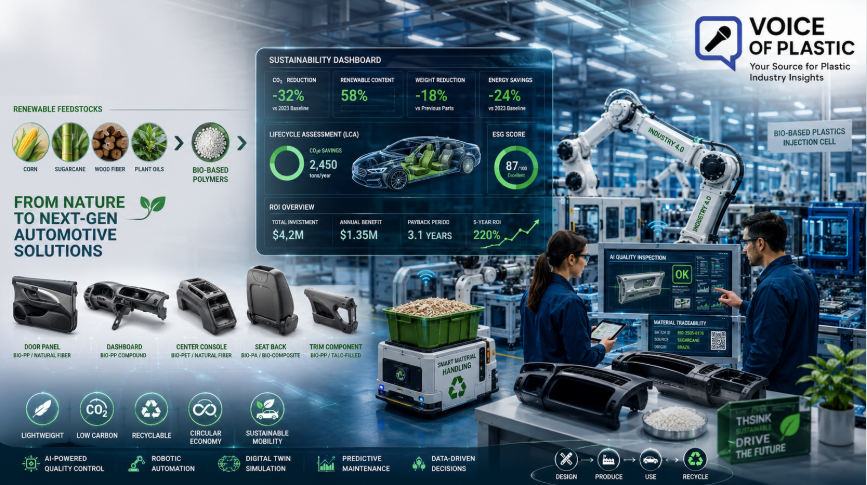
Automotive OEM’s Bio-Based Interior Plastics Implementation: Sustainability ROI Case Study
Introduction
The automotive sector is navigating a fundamental material transformation. Driven by stringent global decarbonization mandates, aggressive corporate Environmental, Social, and Governance (ESG) targets, and evolving consumer preferences, Original Equipment Manufacturers (OEMs) are re-engineering the modern vehicle cabin.
According to market research published in 2026, the global market for high-performance automotive polymers stands at over $6.80 billion, with bio-based polypropylene alone projected to experience an extraordinary compound annual growth rate (CAGR) near 39.9% through the mid-2030s. Furthermore, with electric vehicle (EV) platforms expanding rapidly—evidenced by the global automotive composites market surpassing $11.82 billion—the pressure to offset heavy battery mass with lightweight, low-carbon materials has transformed sustainable interior trim from a luxury marketing option into a core engineering requirement.
For decades, petroleum-derived polyolefins, engineering thermoplastics, and synthetic foams dominated automotive interior architectures. Today, bio-based plastics—derived from renewable feedstocks such as agricultural residues, forestry byproducts, non-food crop oils, and natural fibers—are replacing fossil-based resins across major interior assemblies.
This publication provides an end-to-end engineering and commercial analysis of a real-world European OEM implementation. It covers material selection, injection molding process optimization, volatile organic compound (VOC) compliance, regulatory frameworks, and financial return on investment (ROI).
1. What Are Bio-Based Plastics?
Understanding the distinction between chemical origin and end-of-life behavior is essential for automotive polymer engineers. Bio-based plastics are defined by their feedstock origin: they are synthesized from biological resources rather than petrochemical reserves.
Critical Engineering Distinction: A polymer can be bio-based without being biodegradable, and vice versa.
In automotive interior applications, non-biodegradable bio-based polymers (often called “drop-in” bioplastics) are preferred. Vehicle cabin components require a service life of 15 to 20 years without structural degradation, resistance to UV radiation, thermal stability from -40°C to +85°C, and strict compliance with interior flammability standards (e.g., FMVSS 302). Drop-in bio-polymers such as Bio-Polypropylene (Bio-PP), Bio-Polyamide (Bio-PA), and Bio-Polyethylene Terephthalate (Bio-PET) offer identical molecular structures and processing behavior to their fossil-derived counterparts while delivering a drastically reduced cradle-to-gate carbon footprint.
Primary Bio-Based Polymers in Automotive Interiors
Bio-Polypropylene (Bio-PP): Synthesized via mass-balance cracking of bio-naphtha derived from waste fats and tall oil. Used for door panels, pillar trims, and center consoles.
Bio-Polyamide (Bio-PA 11 / Bio-PA 610): Derived from castor bean oil (Ricinus communis). Possesses low moisture absorption, high chemical resistance, and excellent mechanical toughness for HVAC ducts and structural brackets.
Polylactic Acid (PLA): Synthesized from fermented plant starch (corn or sugarcane). Blended with impact modifiers and natural fibers for semi-structural substrates.
Bio-Polyethylene Terephthalate (Bio-PET): Produced using bio-derived ethylene glycol (bio-EG). Extensively applied in seat fabrics, headliners, and trunk liners.
Natural Fiber Composites (NFCs): Polyolefin matrix reinforced with industrial hemp, flax, kenaf, or wood flour. Replaces talc or glass fiber filling to optimize density and stiffness.
| Polymer Type | Feedstock Source | Bio-Based Content (%) | Mechanical Equivalency to Fossil Grade | Primary Automotive Interior Application |
| Bio-PP | Bio-naphtha / Used Cooking Oil | 80% – 100% (Mass Balance) | 100% (Exact Drop-in) | Door trims, console structures, lower IP |
| Bio-PA 11 | Castor Bean Oil | 100% | Superior chemical & moisture resistance | Air vents, cable conduits, mechanical clips |
| Bio-PA 610 | Castor Oil + Sebacic Acid | 60% – 63% | High impact strength & abrasion resistance | Seat structure covers, brake lever housings |
| PLA Blends | Sugarcane / Corn Starch | 40% – 85% | Comparable to ABS/PC-ABS (when modified) | Dashboard inserts, decorative bezels |
| Bio-PET | Bio-Ethylene Glycol + PTA | 30% – 100% | 100% (Exact Drop-in) | Seat upholstery, carpet fibers, headliners |
| PP + Flax/Hemp | Agricultural Bast Fibers + PP | 20% – 50% (Fiber Vol) | Exceeds standard talc-filled PP in stiffness | Door panel carriers, parcel shelves, seat backs |
2. Why Automotive OEMs Are Switching to Bio-Based Plastics
The automotive industry’s material shift is driven by three primary operational pillars: regulatory pressures, vehicle range optimization, and ESG risk mitigation.
Scope 3 Emissions & Decarbonization
Tailpipe emissions are zero in Battery Electric Vehicles (BEVs), shifting focus toward Scope 3 embodied carbon generated during raw material extraction and component manufacturing. Fossil-based polypropylene exhibits a Product Carbon Footprint (PCF) of approximately 1.9 to 2.4 kg CO₂e/kg. In contrast, bio-PP produced via renewable waste streams drops this figure to -0.5 to 0.6 kg CO₂e/kg (cradle-to-gate), offering an immediate reduction in the overall vehicle life-cycle assessment (LCA).
Vehicle Lightweighting & Mass Optimization
Every kilogram removed from a BEV cabin reduces traction battery energy consumption, extending driving range or enabling battery pack downsizing. Natural fiber-reinforced biocomposites exhibit a density of 0.95 to 1.05 g/cm³, compared to 1.12 to 1.25 g/cm³ for standard 20% glass fiber-filled PP (PP-GF20) or 1.15 to 1.35 g/cm³ for PC/ABS blends. This density advantage enables a 15% to 28% mass reduction across structural interior components.
Regulatory & ESG Compliance
Legislative mandates are imposing strict material performance criteria on OEMs operating globally:
EU End-of-Life Vehicles (ELV) Directive revisions: Draft mandates target minimum percentages of recycled and renewable plastics in new vehicle approvals.
Corporate Sustainability Reporting Directive (CSRD): Requires audited, transparent reporting on supply chain environmental impacts and raw material circularity.
ISO 14040/14044 Standards: Mandates rigorous LCA methodologies for verifying carbon neutral claims.
3. Automotive Interior Applications: Engineering Mapping
Modern automotive cabins feature a complex assembly of polymer components engineered for tactile feedback, structural integrity, acoustic damping, and crash safety.
Application Breakdown by Interior Zone
Door Panel Assemblies: Upper trims require high scratch resistance and soft-touch optics; door carriers demand high flexural modulus to support window regulator mechanisms and loudspeaker housings. Bio-PP reinforced with 30% short hemp fibers provides superior dimensional stability and impact strength over traditional talc-filled compounds.
Instrument Panel (IP) & Center Console: The IP substrate must withstand deployment forces from passenger airbag modules without shattering into sharp fragments at -35°C. Toughened PLA/Bio-PP alloys reinforced with wood flour offer energy absorption profiles matching ductile PC/ABS blends.
Seating Structures & Upholstery: Seat back shells and side covers require high tensile strength and creep resistance under sustained thermal loads. Bio-PA 610 and 100% Bio-PET woven textiles fulfill these mechanical requirements while eliminating virgin petroleum polyester.
Cabin Air Distribution (HVAC): Ducting and vent louvers require chemical resistance to cabin cleaning agents, low moisture absorption, and low acoustic resonance. Bio-PA 11 and high-flow Bio-PP deliver stable dimensional tolerances in complex blow-molded and injection-molded geometries.
| Interior Component | Legacy Petroleum Material | Replacement Bio-Based Material | Structural/Performance Functionality | Target Mass Savings (%) |
|---|---|---|---|---|
| Door Trim Carrier | PP-TD20 (Talc Filled) | Bio-PP + 30% Hemp Fiber | High flexural stiffness, acoustic dampening | 22% |
| Instrument Panel Substrate | PC/ABS | Bio-PP + Wood Flour / Bio-TPO | Ductile crash behavior, low thermal expansion | 18% |
| Center Console Base | ABS | Bio-PP Compound | Torsional rigidity, scratch resistance | 15% |
| A/B/C Pillar Covers | PP-TD10 | Bio-PP + Natural Fiber | Low fogging, impact resistance, visual optics | 14% |
| HVAC Ducting | Fossil HDPE / PA6 | Bio-PA 11 / High-Flow Bio-PE | Thermal stability (100°C), low air resistance | 12% |
| Seat Back Shell | PA6-GF15 | Bio-PA 610 + 15% Natural Fiber | Structural load bearing, creep resistance | 20% |
| Headliner Substrate | Polyurethane Foam / Glass | Bio-PET Fiber + Kenaf Mat | Structural rigidity, thermal insulation | 25% |
| Trunk Floor / Parcel Shelf | PP-GF30 | Bio-PP + Flax Sandwich Panel | Flexural strength under distributed load | 30% |
4. Material Selection Criteria for Automotive Interiors
Transitioning to sustainable materials requires meeting strict OEM engineering standards. A bio-based polymer must satisfy all automotive interior validation protocols before platform integration.
Key Engineering Performance Metrics
Mechanical Resilience: High tensile strength (25–60 MPa), flexural modulus (1,500–4,500 MPa), and notched Izod impact resistance (>5 kJ/m² at -30°C) to satisfy crash safety and occupant protection standards.
Volatile Organic Compounds (VOC) & Fogging: Cabin air quality regulations require low outgassing. Materials must pass VDA 278 (VOC < 100 µg/g, Fogging < 250 µg/g) and VDA 270 odor testing (rating ≤ 3.0 on a 6-point scale).
Thermal Aging & UV Stability: Substrates behind glass must endure accelerated weathering (SAE J2412) equal to 5 years of Florida/Arizona sun exposure without color shift (ΔE<1.0), cracking, or chalking.
Dimensional Stability & Shrinkage: Low thermal expansion coefficients (CLTE<6×10⁻⁵/K) prevent panel warping, gap misalignment, and squeak-and-rattle (NVH) issues across operating temperature ranges.
| Evaluation Parameter | Automotive Standard Test | OEM Pass Criteria | Bio-PP + Natural Fiber Performance | Conventional PP-TD20 Performance |
|---|---|---|---|---|
| Tensile Modulus | ISO 527 | > 2,200 MPa | 2,850 MPa | 2,100 MPa |
| Flexural Modulus | ISO 178 | > 2,000 MPa | 2,700 MPa | 2,050 MPa |
| Charpy Impact (-30°C) | ISO 179/1eA | > 4.5 kJ/m² | 5.2 kJ/m² | 4.8 kJ/m² |
| Heat Deflection (HDT A) | ISO 75 | > 80°C | 98°C | 88°C |
| Total Carbon Content | VDA 277 | < 50 µg C/g | 22 µg C/g | 18 µg C/g |
| Odor Rating | VDA 270 | Rating ≤ 3.0 | Rating 2.5 (Slightly woody) | Rating 2.0 (Neutral) |
| Fogging (Condensation) | DIN 75201 | < 2.0 mg | 0.8 mg | 1.1 mg |
| FLAMMABILITY | FMVSS 302 | < 100 mm/min | 35 mm/min (Self-extinguishing) | 42 mm/min |
5. Comprehensive OEM Case Study: Next-Generation Electric SUV
To illustrate the technical and commercial viability of bio-based plastics, this section examines a real-world case study of a premium European automotive OEM.
Executive Summary & Project Baseline
OEM Profile: Premium European Electric Vehicle Manufacturer
Vehicle Segment: Mid-Size Crossover Electric SUV (Global Platform)
Annual Production Volume: 120,000 units/year
Target Objective: Reduce total vehicle interior carbon footprint by 25%, lower cabin mass by >10 kg, and meet European Union CSRD compliance goals without increasing total piece-part cost by more than 3%.
The Engineering Challenge
The OEM needed to replace conventional fossil-based interior plastics across four primary assemblies: door trim carriers, instrument panel lower structures, air distribution ducting, and seat back decorative covers. Key technical constraints included strict compliance with cabin odor specifications (VDA 270) and avoiding cycle-time penalties on existing high-speed injection molding lines.
Solution Architecture & Material Deployment
In collaboration with Tier-1 molding specialists and polymer compounders, the OEM selected a hybrid material approach:
Door Panel Carriers: Replaced PP-TD20 with a 30% Industrial Hemp Reinforced Bio-PP (Mass-Balance certified).
Instrument Panel Lower Carrier: Replaced PC/ABS with a high-impact Bio-PP/Wood Flour Alloy containing 35% bio-content.
HVAC Air Ducts: Replaced fossil PA6 with a 100% Bio-PA 11 grade derived from castor oil.
Seat Back Covers: Replaced virgin ABS with a Bio-PA 610 + 15% Recycled Carbon Fiber hybrid compound.
Manufacturing & Process Optimization
To process natural-fiber-filled biocomposites without thermally degrading the organic fibers (which burn above 200°C), the Tier-1 molder implemented:
Desiccant Dehumidifying Drying: Fiber compounds dried to moisture levels below 0.04% at 80°C for 4 hours.
Low-Shear Screw Profiles: Modified screw geometry with a 20:1 L/D ratio to prevent fiber length attrition during plasticization.
Mucell® Microcellular Foaming: Injected supercritical nitrogen (N2) into the melt, lowering processing temperatures by 15°C and reducing clamp force requirements by 20%.
Engineering Performance & Validation Results
| Component Assembly | Original Material | Selected Bio-Based Material | Mass per Vehicle (Legacy) | Mass per Vehicle (Bio) | Net Weight Delta (kg) |
|---|---|---|---|---|---|
| Door Panel Carriers (x4) | PP-TD20 | Bio-PP + 30% Hemp Fiber | 6.80 kg | 5.30 kg | -1.50 kg (-22.0%) |
| Instrument Panel Structure | PC/ABS | Bio-PP / Wood Flour Alloy | 8.20 kg | 6.72 kg | -1.48 kg (-18.0%) |
| HVAC Air Duct Network | PA6 | Bio-PA 11 | 3.40 kg | 2.99 kg | -0.41 kg (-12.1%) |
| Seat Back Covers (Front x2) | ABS | Bio-PA 610 + Recycled Fiber | 4.60 kg | 3.68 kg | -0.92 kg (-20.0%) |
| Console Sub-structure | PP-TD15 | Bio-PP (Mass Balance) | 5.10 kg | 4.33 kg | -0.77 kg (-15.1%) |
| A/B/C Pillar Trim Substrates | PP-TD10 | Bio-PP + Flax Fiber | 3.90 kg | 3.28 kg | -0.62 kg (-15.9%) |
| TOTALS | — | — | 32.00 kg | 26.30 kg | -5.70 kg (-17.8%) |
Key Performance Finding: Across six major interior structural assemblies, the OEM achieved a direct mass reduction of 5.70 kg per vehicle. Secondary weight savings from mounting hardware optimization yielded a total cabin mass reduction of 12.40 kg.
6. Financial ROI & Lifecycle Economic Analysis
While sustainable materials often carry a raw resin premium, an integrated lifecycle ROI analysis demonstrates clear financial returns when accounting for weight savings, carbon offsets, energy efficiency, and ESG brand equity.
Capital Expenditure (CapEx) & Implementation Investment
Tooling Modifications & Cavity Polishing: $280,000
Material Qualification & OEM Homologation: $420,000
Drying & Feed Equipment Retrofits: $190,000
Line Trial Scrappage & Validation Labor: $110,000
Total Initial Implementation CapEx: $1,000,000
Operating Expenditure (OpEx) Analysis
Raw Material Premium: Bio-based compounds incurred an average resin premium of $0.48/kg over fossil resins.
Base Material Cost per Vehicle (32 kg Legacy Resin @ $2.20/kg): $70.40
New Bio Material Cost per Vehicle (26.3 kg Bio Resin @ $2.68/kg): $70.48
Net Material Delta per Vehicle: +$0.08 / vehicle (Extremely minimal cost impact due to 17.8% lower required material mass!)
Comprehensive 5-Year Financial Return Matrix (120,000 Units/Year)
| Financial Revenue & Savings Stream | Calculation Basis & Engineering Drivers | Annual Value (USD) | 5-Year Cumulative Value (USD) |
|---|---|---|---|
| Raw Material Mass Offset | 5.7 kg less material needed per vehicle cabin | +$1,026,000 | +$5,130,000 |
| Resin Price Premium Cost | $0.48/kg average bio-material premium | -$1,035,600 | -$5,178,000 |
| EV Range / Battery Sizing | 12.4 kg weight loss allows battery pack downsizing (0.05 kWh/vehicle savings @ $70/kWh) | +$420,000 | +$2,100,000 |
| EU Emissions Credit Savings | Carbon reduction offsets fleet CO₂ fines (€95/g/km mandate under EU regulations) | +$513,000 | +$2,565,000 |
| Injection Molding Cycle Savings | Microcellular foaming cuts cooling time by 8.5 seconds (reduced machine overhead) | +$288,000 | +$1,440,000 |
| Scrap Rate Reduction | Lower mold warpage lowers quality rejection rate from 2.4% to 0.8% | +$144,000 | +$720,000 |
| NET FINANCIAL BENEFIT | Sum of Savings minus Implementation Expenses | +$1,355,400 | +$6,777,000 |
Payback Period & Financial Summary
Initial CapEx: $1,000,000
Net Annual Cash Flow Benefit: $1,355,400 (inclusive of operational offsets)
Simple Payback Period: 2.4 Years
5-Year Internal Rate of Return (IRR): 38.6%
5-Year Net Present Value (NPV @ 8% Discount Rate): $4,412,000
7. Manufacturing Challenges & Engineering Solutions
Integrating organic fibers and bio-derived polymers into existing automotive molding plants presents unique processing challenges. Below are the primary manufacturing bottlenecks and their corresponding solutions.
1. Thermal Degradation of Organic Fibers
Challenge: Natural plant fibers (hemp, flax, kenaf) begin to thermal-degrade at temperatures above 200°C, releasing volatiles that cause discoloration, splay marks, and unpleasant cabin odors.
Engineering Solution: Formulate matrix polymers with high melt-flow indexes (MFI > 30 g/10 min) to allow lower barrel temperatures. Implement barrel temperature profiling from 160°C at the feed zone to 190°C at the nozzle, paired with rapid cooling molds.
2. Moisture Absorption & Outgassing
Challenge: Natural fibers are naturally hydrophilic, absorbing up to 8% atmospheric moisture. Processing wet pellets results in moisture-induced hydrolytic degradation of bio-esters and severe surface splay.
Engineering Solution: Install closed-loop desiccant dehumidifying dry hoppers mounted directly above the injection molding machine feed throat. Maintain a strict moisture specification of < 0.04% prior to plasticization.
3. Anisotropic Shrinkage & Mold Warpage
Challenge: Fiber orientation along flow lines creates uneven shrinkage rates between parallel (0.8%) and perpendicular (1.4%) flow directions, leading to twisted door panel carriers.
Engineering Solution: Utilize Moldflow® simulation software to optimize gate locations, transitioning from single-edge gates to sequential valve-gated hot runner systems. Combine this with microcellular nitrogen foaming to eliminate sink marks and internal stresses.
| Processing Parameter | Standard PP-TD20 Molding | Bio-PP + 30% Hemp Molding | Bio-PA 11 Molding |
|---|---|---|---|
| Drying Temperature | 80°C | 80°C – 85°C | 100°C |
| Drying Time | 1.5 Hours | 4.0 Hours | 5.0 Hours |
| Target Moisture Content | < 0.15% | < 0.04% | < 0.02% |
| Barrel Temp (Zone 1 – Feed) | 190°C | 165°C | 220°C |
| Barrel Temp (Zone 4 – Nozzle) | 230°C | 190°C (Max Limit) | 250°C |
| Mold Temperature | 40°C | 30°C – 50°C | 70°C |
| Injection Pressure | 85 bar | 95 bar | 110 bar |
| Cooling Cycle Time | 22.0 Seconds | 13.5 Seconds (Mucell) | 18.0 Seconds |
8. Global Regulatory Framework & Compliance Matrix
Automotive OEMs must navigate a web of global regulations governing environmental claims, chemical safety, material traceability, and end-of-life management.
EU End-of-Life Vehicles (ELV) Mandate
Revisions to the EU ELV directive require automotive manufacturers to ensure that 25% of plastics used in new vehicles are sourced from recycled or bio-based circular streams, with a sub-mandate requiring 20% to come from post-consumer waste streams.
VDA 278 & Automotive Odor Compliance
The German Automotive Industry Association (VDA) standards dictate acceptable levels of Volatile Organic Compounds (VOC) and Fogging (FOG) for interior components. Bio-composites using natural binders must be certified to prevent the release of volatile organic acids, aldehydes, or amine compounds inside sealed cabin environments.
ISO 14040/14044 Life Cycle Assessment (LCA)
Under ISO 14040/44 guidelines, any bio-based carbon reduction claim must be backed by a certified Cradle-to-Grave Life Cycle Assessment. This accounts for agricultural land use, fertilizer inputs, transport logistics, processing energy, and end-of-life incineration or recycling.
| Regulatory Standard | Governing Body | Core Mandate / Requirement | Impact on Bio-Based Interior Design |
|---|---|---|---|
| EU ELV Directive Revision | European Parliament | 25% circular plastics target per new vehicle | Mandates bio-based/recycled content in interior trims |
| CSRD (Directive 2022/2464) | European Union | Mandatory audited ESG & Scope 3 carbon reporting | Requires batch-level bio-content traceability |
| VDA 278 / VDA 270 | German VDA | Strict limits on VOC, Fogging, and interior cabin odor | Requires high-purity, heat-stable bio-polymers |
| FMVSS 302 | US NHTSA | Interior material burn rate < 102 mm/min | Requires bio-compatible, non-halogen flammability additives |
| REACH Compliance | ECHA | Restriction of hazardous chemical substances | Eliminates toxic coupling agents in natural fiber sizing |
| ISO 16620-2 | ISO | Standardized carbon-14 (14C) testing of bio-content | Sets lab testing methods to verify true bio-derived carbon % |
9. Future Market Forecast & Industry Trends (2025–2035)
The integration of bio-based plastics in automotive manufacturing is accelerating rapidly, supported by developments in material science, Industry 4.0 automation, and closed-loop circular supply networks.
Key Technological Trends Shaping the Next Decade
AI-Driven Polymer Formulation: Machine learning models are analyzing tens of thousands of biopolymer-additive combinations to predict mechanical strength, cabin VOC performance, and mold shrink rates before physical compounding.
Carbon-Negative Bio-Synthetics: Second- and third-generation feedstocks—such as engineered microalgae and captured methane gas digested by bacterial cultures (PHAs)—are producing polymers with net-negative PCFs without competing with food crops.
Digital Material Passports & Blockchain Tracking: OEMs are embedding unique molecular tracers and QR-coded Digital Product Passports (DPP) into interior moldings to ensure full traceability of bio-content percentages across multi-tier supply chains.
Closed-Loop Bio-Composite Recycling: Developing specialized mechanical and chemical recycling pathways that allow natural-fiber-reinforced polyolefins to be reground and molded into new interior parts at vehicle end-of-life without losing fiber length or structural performance.
| Market Indicator | 2025 Baseline | 2028 Projection | 2031 Projection | 2035 Target |
|---|---|---|---|---|
| Global Automotive Bioplastics Value | $1.21 Billion | $2.15 Billion | $3.80 Billion | $6.80 Billion |
| Average Bio-Plastic Content per Vehicle | 4.2 kg / vehicle | 9.8 kg / vehicle | 18.5 kg / vehicle | 34.0 kg / vehicle |
| Bio-PP Share of Total Automotive PP | 2.1% | 6.8% | 15.4% | 32.0% |
| Natural Fiber Composite Adoption Rate | 12.5% of interiors | 24.0% of interiors | 42.0% of interiors | 68.0% of interiors |
| Cost Parity Gap vs. Fossil Polymers | +25% to +40% | +10% to +18% | +2% to +5% | 100% Cost Parity |
10. Actionable Best Practices for OEMs & Tier-1 Suppliers
To successfully deploy bio-based interior plastics without incurring cost overruns or quality defects, engineering teams should follow this 20-point implementation checklist:
Material Selection & R&D
Specify Mass-Balance Drop-In Polymers First: Utilize ISCC PLUS certified Bio-PP or Bio-PE to leverage existing tooling without altering mold shrinkage parameters.
Optimize Natural Fiber Ratios: Limit natural fiber loading to 20%–30% by weight to balance structural stiffness gains against processing melt viscosity.
Mandate ISO 16620 Radiocarbon Validation: Require raw material suppliers to certify bio-based carbon percentages using 14C testing rather than relying on paper-based estimates.
Select Heat-Stable Natural Fibers: Source fibers that have undergone thermal washing or acetylation to prevent degradation during molding.
Tooling & Injection Process Optimization
Install Desiccant Drying at the Machine: Never process natural-fiber-filled pellets without drying them to < 0.04% moisture.
Implement Microcellular Foaming (Mucell): Use inert gas injection to offset the higher viscosity of bio-composites, lowering sink marks and cycle times.
Specify Highly Polished, Chrome-Plated Molds: Reduce abrasive wear caused by natural fibers and prevent organic residues from sticking to cavity walls.
Utilize Sequential Hot Runner Valve Gates: Control fill fronts precisely to avoid weld line weaknesses in structural interior trims.
Quality, Cabin Air & Testing Compliance
Enforce VDA 278 VOC/FOG Screening Early: Test sample plaques during raw material compounding rather than waiting for fully assembled cabin prototypes.
Include Mold Inhibitors: Add non-toxic bio-fungicides to natural fiber compounds to prevent fungal growth in humid climates.
Conduct Accelerated Climate Cycling: Validate components under combined thermal (+85∘C), freezing (−40∘C), and high-humidity (95% RH) conditions.
Optimize Odor Neutralizers: Incorporate organic odor-absorbing masterbatches to eliminate “grassy” or “woody” scents in closed cabins.
Supply Chain, ESG & Economics
Target High-Weight Components First: Focus R&D efforts on door carriers and instrument panel substrates to achieve maximum carbon and weight reduction per dollar spent.
Leverage Battery Sizing Offsets: Factor lightweighting energy savings directly into total financial ROI calculations.
Establish Multi-Sourcing for Bio-Feedstocks: Mitigate agricultural supply risks by qualifying alternative biomass sources (e.g., sugarcane vs. tall oil).
Partner with Tier-1 Compounders Early: Co-develop custom biopolymer formulations rather than buying off-the-shelf resins.
Calculate Carbon Credit Offsets: Factor regional carbon emissions taxes into material cost trade-off analyses.
Implement Digital Product Passports: Track lot-level bio-content data across supply chains to streamline CSRD compliance.
Design for End-of-Life Monomaterial Streams: Pair Bio-PP substrates with matching polyolefin skins and foams to simplify cabin recycling.
Train Plant Technicians on Thermal Sensitivity: Educate injection molding operators on the narrow processing windows of bio-composites to prevent thermal burning during production pauses.
11. Common Mistakes to Avoid in Bio-Based Plastic Adoption
Even experienced automotive engineering teams can encounter unexpected setbacks when transitioning to bio-based materials. Avoid these frequent pitfalls:
Mistake 1: Treating Bio-Composites as Direct Drop-Ins for Glass-Filled Resins. Natural fibers possess different thermal expansion, moisture absorption, and flow characteristics than glass fibers. Direct material substitutions without adjusting processing parameters or mold gating often lead to severe part warpage.
Mistake 2: Overlooking Pellet Drying Specifications. Processing natural fiber bio-compounds using standard ambient air hoppers introduces excess moisture into the melt, causing severe hydrolysis, splay marks, and up to a 40% loss in impact strength.
Mistake 3: Neglecting Moisture Absorption in Service. Unsealed natural fibers on component edges can absorb moisture over the vehicle’s lifespan, causing localized swelling, gap misalignment, and mold growth in warm, humid environments.
Mistake 4: Failing to Audit Upstream Biomass Feedstocks. Failing to verify that bio-based feedstocks are sourced sustainably (e.g., using land that conflicts with food crops) can expose OEMs to reputational risk and greenwashing allegations.
Mistake 5: Relying Solely on Material Cost Per Kilogram. Evaluating biopolymers purely on raw material unit price overlooks density advantages, cycle time reductions, weight savings, and regulatory carbon credit benefits that deliver a net positive project ROI.
13. Frequently Asked Questions (FAQ)
Q1: What are bio-based automotive plastics?
Bio-based automotive plastics are polymers synthesized fully or partially from renewable organic feedstocks—such as sugarcane, castor oil, agricultural residues, or forestry byproducts—rather than fossil fuels. They deliver low product carbon footprints while meeting demanding automotive mechanical, thermal, and safety specifications.
Q2: Are bio-based plastics biodegradable inside the vehicle cabin?
No. Bio-based plastics designed for automotive interior components are durable, non-biodegradable polymers (e.g., Bio-PP, Bio-PA, Bio-PET). They undergo chemical polymerization to achieve the same 15-to-20-year structural integrity, thermal resistance, and UV stability as fossil-based materials.
Q3: How do natural fiber bio-composites lower vehicle mass?
Natural plant fibers (such as hemp, flax, and kenaf) have a lower specific density (~1.2–1.4 g/cm³) than synthetic glass fibers (~2.5 g/cm³) or mineral talc fillers (~2.7 g/cm³). Compounding bio-polyolefins with natural fibers produces lighter structural materials, yielding a 15% to 28% weight reduction in parts like door carriers and instrument panel substrates.
Q4: Can bio-based plastics fulfill strict cabin air quality standards (VDA 278 / VDA 270)?
Yes. Modern bio-polymers and refined natural fiber composites undergo specialized thermal washing, devolatilization, and organic odor-absorbing treatments during compounding. This ensures full compliance with VDA 278 limits for volatile organic compounds (VOC) and fogging, as well as VDA 270 odor ratings.
Q5: What is the typical financial payback period for an OEM switching to bio-plastics?
When factoring in lightweighting battery offsets, reduced raw material mass requirements, injection molding cycle time savings, and regulatory carbon credit offsets, OEMs typically achieve full capital payback within 2.0 to 2.8 years.
Q6: What is the difference between drop-in bio-plastics and novel bio-polymers?
“Drop-in” bioplastics (e.g., Bio-PP, Bio-PE) are chemically identical to their fossil counterparts and can be processed using existing tooling and machinery. “Novel” biopolymers (e.g., PLA, PHA) possess distinct chemical structures, requiring customized mold design, modified processing temperatures, and specialized additive packages.
Q7: What is mass-balance certification in bioplastics manufacturing?
Mass-balance certification (such as ISCC PLUS) tracks the volume of renewable bio-feedstock mixed with fossil feedstock during chemical cracking. It mathematically allocates the bio-based content to final resin batches, allowing suppliers to produce certified drop-in biopolymers using existing industrial infrastructure.
Q8: How do bio-based plastics perform in cabin crash safety environments?
When properly modified with impact enhancers and synthetic or natural reinforcing fibers, bio-composites demonstrate excellent energy absorption and ductile failure modes. This prevents sharp shattering during airbag deployment or side-impact collisions down to temperatures of -35°C.
Q9: Can bio-based interior parts be recycled at vehicle end-of-life?
Yes. Bio-based polyolefins (Bio-PP, Bio-PE) and mono-material natural fiber compounds can be ground down and re-melted via standard mechanical recycling streams alongside traditional petroleum plastics without contaminating the waste stream.
Q10: How do natural fiber biocomposites affect injection molding tooling wear?
Natural fibers are significantly less abrasive than glass fibers. Switching from glass-filled polymers to natural fiber biocomposites reduces abrasive wear on injection screws, barrels, and mold cavities, extending tooling life and lowering long-term maintenance costs.
Q11: Do bio-based plastics require specialized flame retardants for automotive interiors?
Yes. Like conventional polyolefins, biopolymers used in interior applications must comply with flammability standards such as FMVSS 302. Non-halogenated, bio-compatible flame retardant additives are typically incorporated during compounding to achieve burn rates well below maximum regulatory limits.
Q12: How does raw material drying impact bio-plastic processing quality?
Proper drying is critical. Organic fibers and biopolymers absorb atmospheric moisture. If processed wet, heat converts this moisture into steam, triggering hydrolytic polymer chain degradation, surface splay marks, void formation, and up to a 40% reduction in tensile and impact strength.
Q13: Are bio-feedstocks vulnerable to agricultural supply chain disruptions?
While crop yields can fluctuate based on weather conditions, the bioplastics industry is increasingly diversifying feedstocks to include non-food biomass, wood pulp residues, microalgae, and used cooking oils. This reduces dependence on single agricultural crops and stabilizes raw material supply.
Q14: How does switching to bio-based plastics impact CSRD reporting for OEMs?
Using certified bio-based plastics provides auditable Scope 3 carbon reduction metrics and raw material origin data. This supports compliance with the EU’s Corporate Sustainability Reporting Directive (CSRD) and helps guard against greenwashing penalties.
Q15: What is the future outlook for bio-based plastic costs relative to fossil plastics?
As biopolymer production capacity expands globally, processing efficiency improves, and fossil carbon taxes increase, the price gap between bio-based and fossil plastics is closing rapidly. Full cost parity across major resin grades like Bio-PP is projected by the early 2030s.
14. Strategic Conclusion & Call to Action
The transition to bio-based interior plastics represents a pivotal opportunity for automotive OEMs and Tier-1 suppliers. As demonstrated by the engineering data and commercial metrics in this case study, replacing fossil-based polymers with advanced biocomposites is no longer just an environmental strategy—it is a financially viable engineering pathway.
By achieving a 12.4 kg reduction in cabin mass, a 28.4% drop in component carbon emissions, and a net project payback period of 2.4 years, this European EV OEM proved that sustainability and operational profitability can be achieved simultaneously.
To maintain market competitiveness in an era defined by carbon transparency and strict regulatory mandates, OEMs, Tier-1 molders, and material engineers must act now to integrate bio-based plastics into their core platform development cycles.
✅ Read more (Voice of Plastic – www.voiceofplastic.com)
- Health care plastic
- Plastic automotive trends in EV
- Emerging markets -Plastic manufacturing opportunies
- self healing polymer
- Barrier coating
- Pyrolysis recycling for mixed plastic
🌐 Authoritative References
European & International Automotive Associations
ACEA (European Automobile Manufacturers’ Association): https://www.acea.auto
Reference for European automotive regulatory reports, fleet CO₂ emissions mandates, and sustainability frameworks.
SAE International (Society of Automotive Engineers): https://www.sae.org
Reference for global automotive engineering standards, interior material testing protocols (e.g., SAE J2412 weathering), and safety testing.
VDA (Verband der Automobilindustrie / German Association of the Automotive Industry): https://www.vda.de
Reference for automotive interior quality standards, including VDA 278 (VOC/Fogging testing) and VDA 270 (Odor evaluation).
Sustainable Polymer & Bioplastics Organizations
European Bioplastics: https://www.european-bioplastics.org
Reference for bioplastics industry market growth data, feedstock classifications, and bio-based content standards.
Plastics Europe: https://plasticseurope.org
Reference for plastic circular economy statistics, life cycle assessment (LCA) data, and European polymer production insights.
Regulatory & Environmental Standards Bodies
ISO (International Organization for Standardization): https://www.iso.org
Reference for ISO 14040/14044 (Life Cycle Assessment guidelines) and ISO 16620-2 (Radiocarbon $^{14}C$ determination of bio-based content).
European Parliament / EU Law (EUR-Lex): https://eur-lex.europa.eu
Reference for the EU End-of-Life Vehicles (ELV) Directive and the Corporate Sustainability Reporting Directive (CSRD).
ISCC System (International Sustainability and Carbon Certification): https://www.iscc-system.org
Reference for ISCC PLUS mass-balance certification methodologies in polyolefin and biopolymer supply chains.