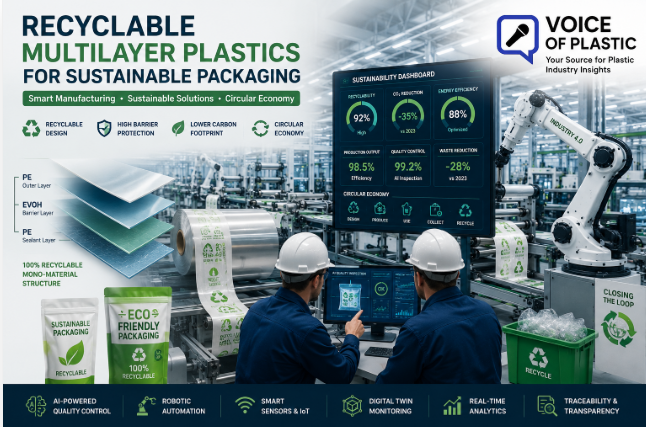
What Are Multilayer Plastics? Engineering Marvels, Recycling Nightmares
Multilayer plastics are sophisticated engineered structures composed of distinct layers of different polymers, adhesives, and sometimes metallic foils. These layers are combined through co-extrusion or lamination to create a single film that possesses the combined functional properties of each component.
Typically, a performance multilayer film consists of:
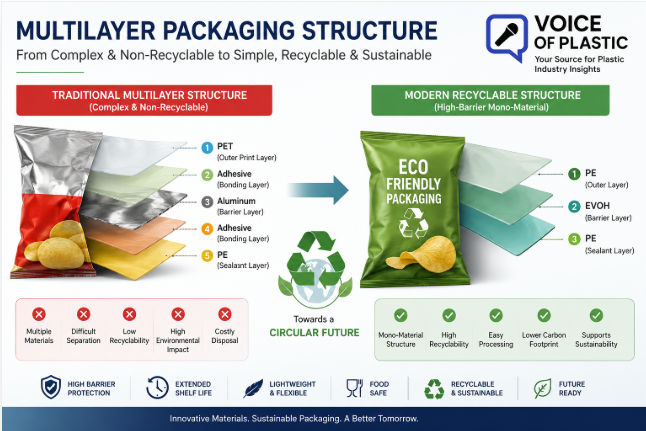
Outer Layer (Print/Protection): e.g., PET (Polyethylene Terephthalate) or BOPP (Biaxially Oriented Polypropylene) for thermal resistance, gloss, and printability.
Tie Layers (Adhesives): Formulated polymers to bond incompatible main layers.
Barrier Layer: e.g., EVOH (Ethylene Vinyl Alcohol) for oxygen barrier, or Aluminum foil for total light/moisture barrier.
Inner Layer (Sealant): e.g., LDPE (Low-Density Polyethylene) or CPP (Cast Polypropylene) for heat sealing capabilities and food contact.
While a traditional structure might look like PET / Adhesive / Alu / Adhesive / PE, the push toward circularity is driving the development of complex PE / Tie / EVOH / Tie / PE structures, where the bulk material is compatible with standard recycling streams.
Common Polymer Combinations
| Polymer | Role in Multilayer Structure | Primary Property | Recyclability in Mixed Form |
| PE (LDPE, HDPE, LLDPE) | Sealant, Bulk structure | Moisture barrier, sealing, toughness | High (in pure streams) |
| PP (BOPP, CPP) | Structure, Heat resistance | Clarity, heat resistance, moisture barrier | High (in pure streams) |
| PET (BOPP, Metallized) | Outer layer, Printing | Strength, heat resistance, clarity, moderate barrier | High (as bottles, difficult as film lamination) |
| PA (Nylon) | Barrier, Strength | Puncture resistance, oxygen barrier | Major contaminant in PE/PP streams |
| EVOH | High Barrier | Exceptional oxygen/gas barrier | Contaminant >5%, requires compatibilizers |
| Aluminum Foil | Absolute Barrier | Light, oxygen, moisture barrier | Non-recyclable in standard plastic mechanical recycling |
Why Multilayer Packaging Dominates the Market
Before addressing the recycling challenges, suppliers must acknowledge why these materials are indispensable to modern supply chains. They facilitate resource efficiency in ways rigid packaging cannot match.
Exceptional Barrier Protection: They provide tailored barriers against oxygen, moisture, light, and aroma, essential for preserving perishable goods.
Extended Shelf Life: For food products, this reduces food waste—a carbon footprint factor often greater than the packaging itself.
Material Reduction (Lightweighting): Multilayer films can achieve necessary performance at a significantly lower weight than rigid glass, metal, or single-layer thick plastics, reducing transportation emissions.
Versatility and Sealability: They enable high-speed manufacturing (Form-Fill-Seal) and complex pouch designs (stand-up pouches, fitments).
The Core Problem: Why Recycling Multilayer Plastics Is Difficult
The very engineered complexity that makes multilayer films functional is what makes them technically and economically challenging to recycle.
1. Material Incompatibility (The Thermodynamic Challenge)
Most common packaging polymers (e.g., PE and PET) are thermodynamically incompatible. When melted together during mechanical recycling, they do not form a homogeneous blend. Instead, they form a weak, phase-separated structure with poor mechanical properties, rendering the resulting “ricasso” virtually useless for high-value applications.
2. Failure of Current Sorting Infrastructure
Standard Material Recovery Facilities (MRFs) utilize Near-Infrared (NIR) optical sorters. While highly effective at identifying rigid mono-material bottles, standard NIR cannot effectively distinguish the individual layers within a 100-micron multilayer film. It usually detects only the dominant surface polymer. If a PE film has a thin layer of PET for printability, it may be sorted into the PE stream, contaminating it. Furthermore, two-dimensional flexible films tend to flat-out and cover other objects on sorting belts or get tangled in rotating equipment.
3. Delamination Difficulties
To recycle the pure polymers, the layers must be separated. The adhesives and tie layers used in traditional lamination (e.g., polyurethane reactive adhesives) are often designed to be permanent. Separating these layers economically at scale is a significant technical bottleneck.
[IMAGE SUGGESTION: Recycling Process Flow Diagram](A flowchart illustrating the current pathway vs. the desired future pathway for flexible packaging, highlighting critical bottlenecks at sorting and material separation).
4. Economic Viability
The cost of collecting, aggregating, transporting, sorting, cleaning, and processing mixed multilayer films often exceeds the market value of the resulting low-grade recycled resin. Until recently, there was little legislative or market pull to bridge this economic gap.
Global Regulations Driving the Shift to Circularity
Suppliers cannot ignore the regulatory Tsunami. Governments are no longer requesting sustainability; they are mandating it through Extended Producer Responsibility (EPR) and material-specific taxes.
Europe: Setting the Standard (PPWR)
The proposed EU Packaging and Packaging Waste Regulation (PPWR) is the most significant driver. Key anticipated mandates include:
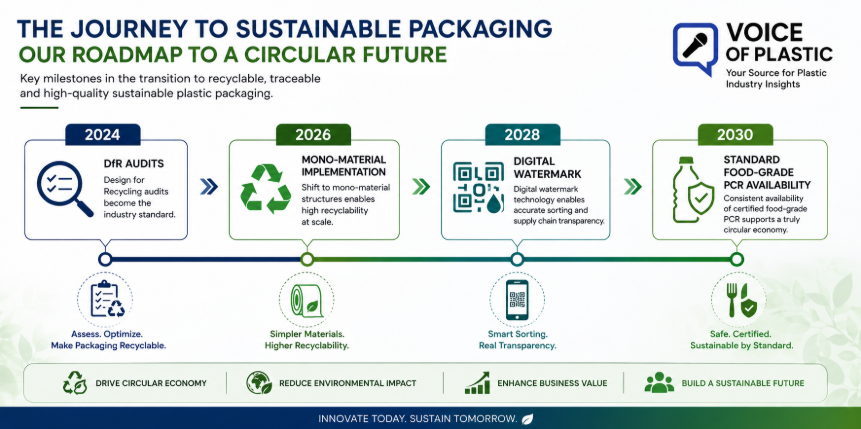
Design for Recycling (DfR): All packaging must be designed for recycling by 2030, scaled by 2035.
Recycled Content Mandates: Minimum percentages of Post-Consumer Recycled (PCR) content in plastic packaging by 2030 (e.g., 30% for contact-sensitive packaging).
EPR Modulation: Fees will be modulated based on recyclability performance (Grade A to E). Non-recyclable multimaterials will face prohibitive costs.
United States: State-Level Activity
While no federal EPR law exists, states like California (SB 54), Oregon, Colorado, and Maine have passed EPR legislation that will penalize non-recyclable flexible packaging.
Material Compatibility and Sorting Standards
Industry bodies such as RecyClass (Europe) and the Association of Plastic Recyclers (APR, USA) have established rigorous testing protocols and design-for-recycling guidelines. These are now being referenced in legislation to define what truly constitutes “recyclable.“
| Regulation/Initiative | Region | Key Impact on Multilayer Plastics | Status (2025) |
| PPWR (Proposed) | EU | Mandates Design for Recycling criteria; modulated EPR fees. | Near Finalization |
| UK Plastic Packaging Tax | UK | £217.85/tonne tax on plastic packaging with <30% recycled content. | Active |
| SB 54 | California, USA | Requires all packaging to be recyclable or compostable by 2032. | Phased Implementation |
| Plastic Waste Management Rules | India | Mandate for 100% recycling of flexible plastics by Phase IV. | Active |
Innovative Solutions and Technologies for Suppliers
To overcome these challenges, packaging suppliers must invest in advanced material science and collaborate across the value chain. Here are the primary technological avenues.
1. The Mono-Material Transition (Design for Recycling)
The most immediate and commercially viable solution for mechanical recycling is simplifying structures into mono-material families. The industry goal is to develop structures that are >90% or even >95% by weight of a single polymer type (primarily PE or PP), making them compatible with existing flexible recycling streams.
PE-based High Barrier Films: Utilizing advanced polymer engineering (e.g., machine direction orientation – MDO-PE) to enhance the stiffness and heat resistance of PE, allowing it to replace PET outer layers. Barrier performance is achieved by incorporating minimal amounts of EVOH (typically <5%) or SiOx/AlOx vacuum coatings, which do not disrupt PE recycling streams when managed correctly.
BO-PP Structures: Similar advances in Biaxially Oriented PP (BOPP) allow for heat-resistant, high-clarity mono-PP structures suitable for dry foods and confectionery.
2. Performance-Enhancing Additives and Compatibilizers
For structures where different polymers are essential, suppliers can utilize compatibilizers. These are specialized block copolymers with affinity for both incompatible polymers (e.g., a PE-g-MAH compatibilizer for PE/PA blends).
Role: When added during the recycling process (or incorporated in the original film design), they dramatically improve the interfacial adhesion between different plastic phases, resulting in recycled materials with significantly better mechanical properties.
3. Chemical Recycling (Advanced Recycling)
When mechanical recycling fails (e.g., highly contaminated, complex multi-material films), chemical recycling technologies offer a complementary solution. These processes break down plastic waste into their original chemical building blocks (monomers or feedstock).
Pyrolysis: Converts mixed plastics into pyrolysis oil, which can replace fossil feedstock in steam crackers to produce virgin-quality polymers. This is ideal for complex multilayer films containing PE and PP.
Solvent-based Extraction (Physical Recycling): Targeted solvents dissolve specific polymers from a multi-material structure, allowing the recovery of pure, virgin-like resin without breaking chemical bonds. Several technologies are scaling to delaminate PET/PE and PE/Alu structures.
Comparison of Mechanical vs. Chemical Recycling
| Attribute | Mechanical Recycling | Chemical Recycling (Pyrolysis) | Solvent-Based Recycling |
| Feedstock Requirement | Clean, sorted, mono-material | Mixed, contaminated, multi-material | Specific multi-material sorted |
| Output Quality | Downcycled (usually) | Virgin-quality | Virgin-quality |
| Process | Physical grinding, washing, melting | Thermal degradation to oil | Dissolution and precipitation |
| Carbon Footprint | Low | Higher (currently) | Moderate |
| Technology Maturity | High | Low to Moderate (scaling) | Low to Moderate |
4. Advanced Sorting and Digital Technologies
The industry is moving toward “Packaging 4.0″ to solve sorting challenges.
Digital Watermarks (HolyGrail 2.0): Imperceptible codes printed on packaging surface. When scanned by standard MRF cameras, they provide detailed information about the material composition (e.g., “5-layer high-barrier PE-based pouch”).
AI and Machine Learning in Sorting: Sorters trained on vast datasets can identify and separate flexible packaging by form factor and anticipated composition more accurately than raw NIR.
Critical Challenges for Packaging Suppliers in 2025–2026
Despite the available solutions, suppliers face significant headwinds in implementation.
Functional Parity vs. Mono-Materials: Replicating the barrier, optics, and running speeds of a complex PET/Alu/PE laminate with a mono-PE structure is technically difficult. Achieving equivalent shelf life for sensitive products is the primary hurdle.
Cost and Capital Investment: Developing mono-material solutions often requires investment in new assets (e.g., MDO-PE lines, specialized extrusion dies) and involves higher raw material costs per function, at least initially.
Supply Chain for PCR: Meeting recycled content mandates is constrained by a severe shortage of high-quality, food-grade Post-Consumer Recycled (PCR) resin, particularly PP and PE.
Operational Performance: Mono-materials often have a narrower “operating window” on existing Form-Fill-Seal (FFS) lines, requiring packers to slow down production or upgrade equipment.
Strategic Checklist for Packaging Suppliers (A 20-Point Plan)
To transition effectively, packaging suppliers should adopt the following best practices:
Map Current Portfolio: Audit all existing multilayer structures and assess their recyclability against RecyClass/APR guidelines.
Adopt Design for Recycling (DfR): Use DfR as the fundamental requirement for all new product development.
Prioritize Mono-Materials: Make mono-PE or mono-PP the default starting point for flexible packaging redesign.
Invest in MDO Technology: Leverage Machine Direction Orientation to enhance the physical properties of PE and PP.
Master Barrier Integration: Develop expertise in applying minimal EVOH (<5% weight) or vacuum coatings (AlOx/SiOx) within mono-streams.
Collaborate with Adhesive Suppliers: Source and validate new ‘recycling-friendly’ or wash-off adhesives.
Optimize PCR Integration: Develop capabilities to incorporate PCR content into non-food contact layers and seek FDA/EFSA approvals for food-grade PCR.
Educate Customers (Brand Owners): Proactively present recyclable alternatives to brands, explaining performance trade-offs and regulatory necessities.
Invest in Traceability: Prepare for “Digital Product Passports” by implementing internal batch-level traceability from raw material to finished film.
Validate Processability: Conduct extensive trials on customers’ packing lines to ensure mono-materials perform adequately.
Conduct Life Cycle Assessments (LCAs): Quantify the environmental benefits of new structures, ensuring they offer a genuine net improvement.
Engage with Recyclers: Collaborate with waste management companies to test sortability and recyclability of new designs in real-world conditions.
Explore Chemical Recycling Partnerships: Secure future feedstock or PCR supply through strategic partnerships with advanced recycling technology providers.
Pilot Digital Watermarks: Participate in initiatives like HolyGrail 2.0 to prepare for advanced sorting reality.
Train R&D Teams: Ensure material scientists and packaging engineers are upskilled in circular design principles.
Monitor Legislative Shifts: Dedicate resources to tracking global packaging regulations (PPWR, SB 54).
Utilize Compatibilizers: Incorporate compatibilizers in unavoidable mixed structures to improve the value of process scrap.
Set Ambitious ESG Goals: Align corporate sustainability targets with scientific benchmarks (e.g., SBTi).
Develop a Carbon Strategy: Understand the carbon footprint impact of transitioning from lightweight multilayer laminates to potentially slightly heavier mono-material solutions.
Participate in Industry Consortia: Engage with organizations like CEFLEX, Ellen MacArthur Foundation, and WPO to shape industry standards.
Industry Case Study: Transitioning a High-Barrier Pouch
The Problem: A major pet food manufacturer used a PET / Aluminum Foil / PE stand-up pouch for retort (wet) pet food. The packaging was highly functional but entirely non-recyclable. Brand owners needed a recyclable solution to meet 2025 sustainability commitments.
The Solution: The packaging supplier collaborated with a polymer producer and an adhesive specialist. They developed a high-stiffness, high-barrier mono-material PE structure.
The outer PET was replaced with an MDO-PE film optimized for thermal resistance during the retort process and printability.
The Aluminum foil was replaced by a sophisticated co-extruded core containing a micro-layer of EVOH (representing <5% of total structure weight) with specialized tie layers, providing the necessary oxygen and moisture barrier.
The sealant layer remained a retort-grade cast PE.
The entire structure utilized a new retort-stable polyurethane adhesive designed to be compatible with PE mechanical recycling when diluted.
The Results:
Recyclability: The new pouch was certified as “Recyclable” in the PE stream (e.g., Grade B by RecyClass).
Shelf Life: Achieved functional parity, maintaining product freshness for the required 18 months.
Regulatory Compliance: Future-proofed against upcoming EPR fee modulation and the EU PPWR mandates.
Carbon Footprint: While the structure was slightly heavier (+8%) to achieve performance, the LCA showed a net environmental benefit due to the elimination of the aluminum foil and the high end-of-life recycling rate.
ROI: The packaging supplier secured a long-term contract with the brand owner, positioning themselves as a strategic sustainability partner rather than just a commodity supplier.
Future Outlook: Packaging 4.0 and True Circularity
The future of recyclable multilayer plastics lies at the intersection of material science and digital technology.
By 2030, we anticipate the mainstreaming of:
AI-Optimized Barrier Polymers: New polymers designed by AI to provide functional barriers while being intrinsically compatible with standard polyolefin streams.
Blockchain-Enabled Traceability: Ensuring that the recycled content and material composition claim is verified and unalterable throughout the value chain.
Full-Scale Chemical Recycling: Providing a circular solution for any remaining complex films, creating a closed-loop system for flexible packaging.
Frequently Asked Questions (FAQ)
1. Are all multilayer plastics non-recyclable?
Historically, most were not recyclable in standard mechanical streams due to mixed material layers. However, modern recyclable multilayer plastics (specifically mono-material PE or PP structures) are designed to be fully compatible with existing flexible recycling infrastructure.
2. Can EVOH be recycled in the PE stream?
Yes, but in limited quantities. Most industry guidelines (e.g., RecyClass) accept EVOH up to 5% of the total weight in PE films, provided it is encased within tie layers and appropriate compatibilizers are present in the final recycled blend.
3. What is the difference between mono-material and recyclable multilayer plastics?
They are often the same thing. A “recyclable multilayer” film is typically a mono-material structure—meaning it is composed (>90-95%) of polymers from the same family (e.g., all PE layers), despite having multiple layers for function (e.g., HDPE for stiffness, LLDPE for sealing).
4. How can I measure the recyclability of my packaging?
Suppliers should utilize standardized testing protocols and design guides provided by organizations like RecyClass in Europe or the Association of Plastic Recyclers (APR) in North America. These provide certification systems (Grade A-E).
5. Will chemical recycling replace mechanical recycling?
No, it is a complementary solution. Mechanical recycling is preferred due to its lower carbon footprint and energy use for clean, sorted streams. Chemical recycling is essential for complex, contaminated, or mixed plastic waste that mechanical recycling cannot handle, effectively keeping those materials in the loop.
6. What are the main challenges in switching to mono-PE retort pouches?
The primary technical hurdles are maintaining thermal stability during the retort process (so the pouch does not distort), achieving sufficient oxygen barrier performance without aluminum, and maintaining packing line efficiency (seal integrity at high speeds).
7. What is a “Tie Layer”?
Tie layers are adhesive polymers used during co-extrusion to bond incompatible materials, such as PE to EVOH or PA. They are essential for structural integrity in modern recyclable barrier films.
8. How does digital watermarking help recycle multilayer films?
Digital watermarks are imperceptible codes printed on the packaging. Sorting facilities equipped with detection technology can scan these codes to instantly identify the exact material composition and direct the item to the correct recycling stream, bypassing the limitations of standard NIR sorting.
9. Are there bio-based recyclable multilayer plastics?
Yes. Suppliers are developing structures using bio-based PE or bio-based PP (derived from renewable feedstocks like waste oils). These polymers are chemically identical to their fossil-based counterparts and are fully recyclable within existing PE/PP streams.
10. How will EU PPWR affect packaging suppliers outside of Europe?
Any supplier exporting packaging or packaged goods into the EU must comply with PPWR regulations. They must ensure their packaging meets the Design for Recycling criteria and incorporates the mandatory percentages of recycled content.
11. Can aluminum foil in packaging be recycled?
Aluminum foil laminated to plastic film cannot be recovered in standard mechanical plastic recycling. However, advanced technologies like pyrolysis can recover the aluminum by burning off the organic plastic layers, although this is currently less common at scale than plastic-to-oil pyrolysis.
12. What is Post-Consumer Recycled (PCR) content?
PCR content is material derived from products that have completed their life cycle as consumer items (e.g., milk jugs collected from household recycling). This is distinct from PIR (Post-Industrial Recycled) content, which is factory scrap. Legislation increasingly demands PCR.
13. Is food-grade recycled PP widely available?
As of 2025, food-grade recycled PP (rPP) remains scarce. Achieving the required purity for food contact through mechanical recycling is technically difficult. Much of the future supply is expected to come from chemical recycling (mass balance approach).
14. What are the typical yield losses when recycling flexible packaging?
Yield losses are significant. Contamination (food residue), labels, inks, adhesives, and non-target polymers can result in mechanical recycling yield losses ranging from 25% to over 50%. Improving input quality (e.g., through front-of-store collection) is critical.
15. Are compostable multilayer plastics a viable alternative?
For specific applications (e.g., coffee pods, teabags, fresh produce bags), compostable multilayers are viable if proper industrial composting infrastructure exists. However, for the bulk of global food packaging, recyclable (circular) plastics are generally preferred due to their established scaling potential and resource efficiency.
Conclusion: The Supplier’s Call to Action
The transition to recyclable multilayer plastics is the most significant material science and commercial challenge facing packaging suppliers in decades. The technical barriers—achieving high barrier performance within mono-material constraints, securing high-quality PCR, and managing manufacturing complexities—are formidable.
However, the risk of inaction is far greater. Regulators, brands, and consumers are demanding circularity. Suppliers who continue to rely on obsolete non-recyclable structures will face accelerating market share loss, punitive EPR fees, and reputational damage.
The roadmap is clear: Adopt design-for-recycling principles, invest heavily in R&D for mono-material solutions, and collaborate transparently across the value chain. By transforming multilayer plastics from a waste problem into a circular resource, suppliers can secure their long-term position in the sustainable packaging economy.