
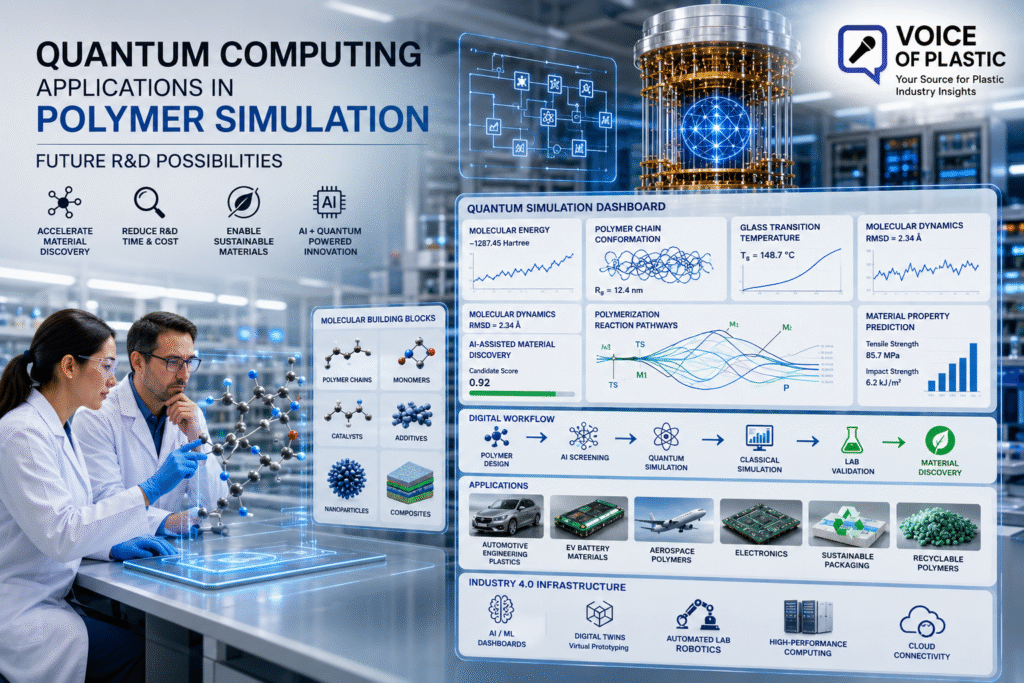
Quantum computing and AI-assisted polymer simulation laboratory showing molecular models, polymer chains, quantum processors, and materials discovery dashboards.
Quantum computing could complement AI and classical simulation to accelerate future polymer materials discovery and R&D.

Quantum Computing in Polymer Simulation: Future R&D Applications

89 / 100 SEO Score

Quantum Computing Applications in Polymer Simulation: Future R&D Possibilities

Introduction

Polymer simulation & development has long depended on a mixture of empirical formulation, laboratory iteration, and computational modeling. Today the balance is shifting decisively toward computation. Modern engineering plastics, high-temperature thermoplastics, battery binders, barrier films, and recyclable packaging grades routinely contain dozens of components—base resins, impact modifiers, stabilizers, fillers, plasticizers, and reactive additives—whose interactions span length scales from angstroms to microns and timescales from femtoseconds to seconds.

Laboratory experimentation alone is expensive and slow. Screening even a few hundred candidate formulations can consume months and generate substantial material waste. High-performance Polymer simulation computing (HPC) clusters running molecular dynamics (MD), density functional theory (DFT), coarse-grained models, and machine-learning surrogates have therefore become indispensable. Yet these classical methods still face well-documented ceilings: exponential scaling of exact electronic-structure methods, sampling bottlenecks in dense entangled melts, and the difficulty of capturing strong electron correlation or rare conformational events at industrially relevant chain lengths.

Against this backdrop, quantum computing has emerged as a research topic of genuine Polymer simulation interest. Polymer simulation & Quantum computers  exploit superposition and entanglement to represent certain many-body quantum states more compactly than classical bits. For polymer science the relevant question is not whether quantum hardware will “revolutionize plastics overnight,” but whether, and under what conditions, quantum or hybrid quantum-classical algorithms can usefully complement the established classical and AI toolkit. This article examines that question with technical precision, distinguishing established methods, current noisy intermediate-scale quantum (NISQ) research, hybrid approaches, near-term possibilities, and longer-term R&D opportunities.

What Is Quantum Computing?

A classical bit is either 0 or 1. A quantum bit, or qubit, can exist in a coherent superposition of both states simultaneously. When multiple qubits become entangled, the joint state space grows exponentially with the number of qubits—exactly the mathematical structure that appears in the many-electron wave function of quantum chemistry or in certain statistical-mechanical models of dense polymers.

Quantum gates manipulate these superpositions. Algorithms such as the variational quantum eigensolver (VQE), quantum phase estimation (QPE), and quantum annealing exploit interference to extract useful expectation values or ground-state approximations. “Quantum advantage” is achieved when a quantum device solves a well-defined problem faster or more accurately than the best classical algorithm running on the best available classical hardware.

Present-day devices are NISQ machines: they possess tens to a few hundred noisy physical qubits, limited coherence times, and imperfect gates. Error correction capable of producing large numbers of logical qubits is still under active development. Fault-tolerant quantum computers with thousands of logical qubits remain a longer-term goal. For polymer scientists the practical analogy is useful: today’s quantum processors resemble early DFT codes of the 1970s—scientifically exciting, limited in system size, and most productive when tightly coupled to classical methods.

What is Polymer simulation

Quantum Computing in Polymer Simulation
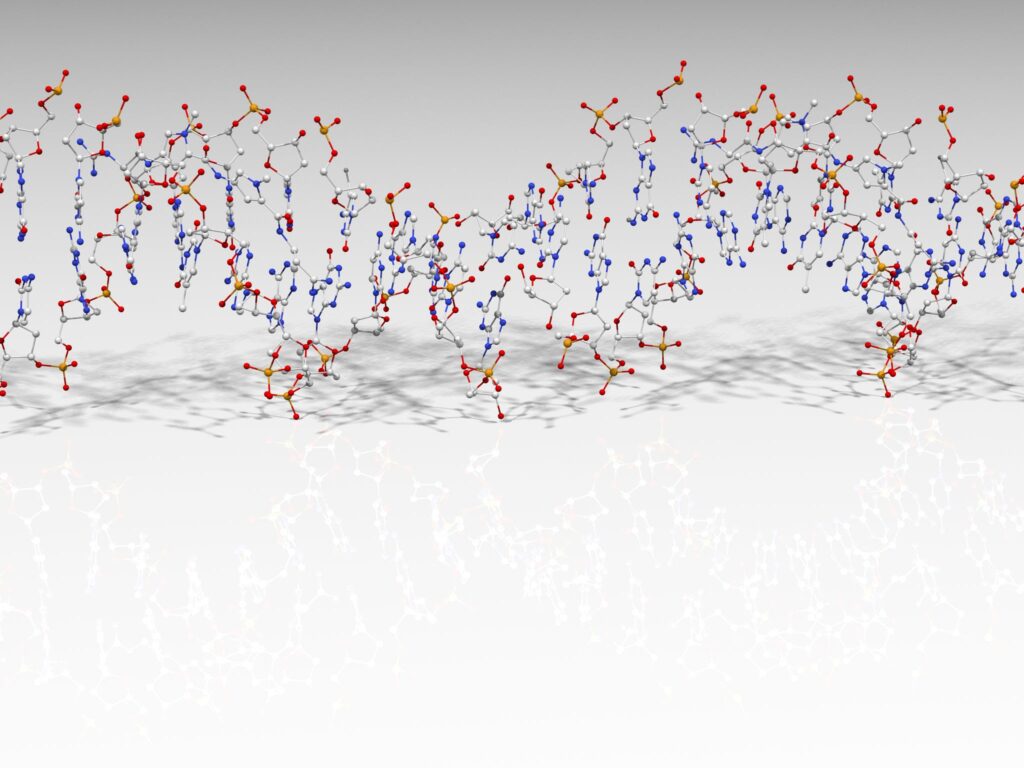
a ball and stick model of a strand of dna.
A ball-and-stick model of a strand of DNA.

Polymer simulation is the use of computational models and numerical methods to predict, understand, and optimize the structure, dynamics, properties, and processing behavior of polymer materials at molecular, mesoscopic, and continuum scales.

Polymers are long-chain molecules (or networks) whose properties emerge from the collective behavior of thousands to millions of atoms. Direct experimental observation of every relevant length and time scale is often impossible or prohibitively expensive. Simulation bridges that gap by solving physical equations (or statistical approximations of them) on computers.

Main Goals -Polymer simulation

  • Predict material properties (glass-transition temperature Tg T_g , modulus, viscosity, permeability, thermal stability, dielectric constant, etc.) before synthesis.
  • Understand molecular mechanisms (chain entanglement, crystallization, phase separation, diffusion, degradation).
  • Screen formulations, additives, and processing conditions to reduce laboratory trial-and-error.
  • Support multiscale materials design, from monomer chemistry to final part performance.

Hierarchy of Scales and Methods

ScaleTypical MethodsWhat Is ResolvedTypical System Size / Time
Atomistic / MolecularMolecular Dynamics (MD), Monte Carlo (MC), Quantum Chemistry / DFTIndividual atoms, bonds, angles, non-bonded interactionsHundreds to ~10⁶ atoms; picoseconds to microseconds
Mesoscale / Coarse-grainedCoarse-grained MD, Dissipative Particle Dynamics (DPD), Lattice modelsGroups of atoms or monomers treated as beadsLarger volumes, longer times (microseconds to milliseconds)
Continuum / MacroscopicFinite Element Analysis (FEA), Computational Fluid Dynamics (CFD)Bulk mechanical, thermal, or flow behaviorReal component sizes; seconds to process timescales


Multiscale modeling links these levels: quantum or atomistic results parameterize coarse-grained models, which in turn inform continuum simulations.

Core Techniques-Polymer simulation

  • Molecular Dynamics (MD): Numerically integrates Newton’s equations of motion using classical force fields (or, more rarely, ab initio forces). Widely used for dynamics, mechanical properties, and Tg T_g estimation.
  • Monte Carlo (MC): Samples configuration space according to statistical mechanics; strong for equilibrium thermodynamics and phase behavior.
  • Density Functional Theory (DFT) and quantum chemistry: Calculate electronic structure of monomers, oligomers, catalysts, or reactive sites.
  • Coarse-grained and continuum methods: Extend accessible length and time scales by sacrificing atomic detail.
  • Machine-learning / AI surrogates: Increasingly used to accelerate property prediction or force-field development once trained on simulation or experimental data.

Polymer simulation & Polymer development is transitioning from empirical trial-and-error to digital discovery. As demand accelerates for specialized engineering thermoplastics in electric vehicles, 6G electronics, aerospace, and circular packaging, conventional computing faces significant limits. Calculating exact electronic structures, multi-reference transition states in polymerization catalysts, and dense entangled polymer phase behavior requires solving Schrödinger’s equation—a task that scales exponentially on classical supercomputers.

Quantum computing in Polymer simulation offers a new approach. By utilizing qubits that leverage superposition and entanglement, quantum computers natively represent correlated electronic wavefunctions without exponential computational slowdown. However, a pragmatic perspective is essential: quantum computers will not replace classical Molecular Dynamics (MD) or Density Functional Theory (DFT) in the short term. Instead, near-term quantum computing acts as a hybrid co-processor to solve complex electronic structure and optimization problems within broader multiscale simulation pipelines.

Why Polymer Simulation Is Computationally Difficult

Polymers are among the most challenging soft-matter systems to model. A single high-molecular-weight chain already contains thousands of atoms; an entangled melt or a filled composite quickly reaches millions of atoms. Key difficulties include:

  • Enormous conformational space and slow relaxation of entangled chains.
  • Long-range non-bonded interactions, electrostatics, and solvent effects.
  • Competition between crystalline, amorphous, and interphase regions.
  • Multi-component thermodynamics (blends, copolymers, additives, fillers).
  • Reactive events (polymerization, crosslinking, degradation, depolymerization).
  • Strong electron correlation in certain conjugated or metal-containing systems.

Atomistic MD captures local dynamics but struggles with entanglement relaxation times. Coarse-grained models extend accessible timescales at the cost of chemical specificity. DFT and wave-function methods deliver electronic structure for oligomers or small fragments but become intractable for realistic chain lengths. Multiscale workflows attempt to bridge these regimes, yet each hand-off introduces approximations and uncertainty. Quantum approaches are being explored precisely for those sub-problems that map naturally onto quantum many-body Hilbert spaces—electronic structure of monomers/catalysts and certain discrete configuration spaces of dense lattice polymers.

Current Methods Used for Polymer Simulation

TechniqueTypical System Size / TimescaleStrengthsLimitationsPotential Quantum Complement
Molecular Dynamics (MD)10⁴–10⁶ atoms, ns–µsDynamics, mechanical properties, Tg estimatesForce-field accuracy, sampling of rare eventsImproved force fields from quantum chemistry
Monte CarloLattice or continuum ensemblesEquilibrium sampling, phase behaviorSlow dynamics of dense systemsQUBO reformulations for dense melts
Density Functional Theory (DFT)Tens to hundreds of atomsElectronic structure, reaction energeticsScaling, approximate functionals for strong correlationVQE/QPE for strongly correlated fragments
Wave-function quantum chemistrySmall molecules / oligomersHigh accuracy when feasibleExponential costQuantum algorithms for larger active spaces
Coarse-grained MDMeso-scale, longer timesEntanglement, morphologyLoss of chemical detailHybrid parameterization
Finite Element Analysis (FEA)ContinuumMacroscopic stress, heat transferNo molecular insightMultiscale coupling
Multiscale modelingHierarchicalBridging length scalesConsistency of interfacesQuantum data at the smallest scale
Machine Learning / AIProperty prediction from structureSpeed after trainingData hunger, extrapolation riskQuantum feature maps or hybrid models
High-Performance ComputingAll of the aboveMature, scalableClassical scaling wallsHybrid quantum-classical acceleration


Quantum computing is not positioned to replace this stack. It is being investigated as a specialized accelerator for selected electronic-structure or combinatorial sampling tasks that feed higher-level classical or AI models.

Potential Quantum Computing Applications in Polymer Simulation

1. Molecular Energy Calculations

Accurate ground- and excited-state energies of monomers, oligomers, catalysts, and additives remain central to understanding reactivity, stability, and optical or electronic properties. Classical DFT and post-Hartree–Fock methods are powerful but approximate or expensive for strongly correlated systems. Variational quantum algorithms and, eventually, quantum phase estimation offer a route to treat larger active spaces. Current demonstrations remain limited to small molecules; polymers enter the picture mainly through carefully chosen fragments or model systems.

2. Polymer Chain Conformation-Polymer simulation

Dense melts of ring or linear polymers on lattices exhibit topological constraints that produce extremely long autocorrelation times in conventional Monte Carlo. Reformulating the problem as a quadratic unconstrained binary optimization (QUBO) model has enabled both classical solvers and quantum annealers to sample these ensembles more efficiently, revealing previously inaccessible topological effects. This is one of the clearest near-term polymer-specific results in the literature.

3. Polymerization Reaction Modeling

Catalyst design, initiator efficiency, copolymerization reactivity ratios, and side-reaction energetics all depend on accurate electronic structure. Hybrid quantum-classical workflows can target the critical transition-state or active-site regions while classical methods handle the larger polymeric environment.

4. Polymer Blend Compatibility

Miscibility, interfacial tension, and phase separation are governed by interaction parameters that ultimately originate in electronic structure and conformational entropy. Quantum-derived interaction parameters or improved free-energy estimates for oligomeric models could refine Flory–Huggins or more advanced theories.

5. Additive and Filler Discovery

Flame retardants, plasticizers, antioxidants, graphene, carbon nanotubes, and other nanofillers interact with the matrix at the molecular scale. Quantum calculations(Polymer simulation) on surface chemistry or small-molecule additives, combined with classical MD of the composite, offer a natural hybrid pathway.

6. High-Performance Polymer Discovery

Aerospace resins, EV battery binders and separators, high-temperature engineering plastics, and low-dielectric electronics materials often involve conjugated or heteroatom-rich chemistries where electron correlation matters. Quantum methods are most relevant for the smallest building blocks that set the intrinsic limits of performance.

7. Sustainable Polymer Design

Bio-based monomers, chemical recycling catalysts, depolymerization pathways, and design-for-recyclability all benefit from accurate reaction energetics and selective bond-breaking studies. Computational screening that reduces the number of laboratory trials directly lowers material and energy waste during development

Quantum Computing in Polymer simulation+ AI + Polymer Science

represents one of the most promising hybrid paradigms for next-generation materials discovery. It does not treat quantum computing as a standalone replacement for existing tools. Instead, it combines the strengths of three complementary technologies into hierarchical, multi-scale workflows.

Roles of Each Component

ComponentPrimary StrengthTypical Contribution in Polymer R&DCurrent Maturity
Artificial Intelligence / Machine LearningRapid screening of large chemical spaces; pattern recognition; surrogate modelingFilters millions of candidates, predicts properties (Tg, modulus, solubility, etc.), generates new molecular structures, accelerates force-field developmentHigh – already used industrially
Quantum ComputingHandling certain quantum many-body problems and discrete combinatorial sampling more naturallyElectronic structure of strongly correlated fragments, reaction energetics, dense polymer configuration sampling (via QUBO encodings), quantum feature maps for MLEmerging / Research (NISQ era)
Classical Polymer Simulation & HPCReliable dynamics, large-system modeling, continuum propertiesMolecular dynamics, coarse-grained simulations, finite-element analysis, process modelingMature and production-ready


The power lies in the orchestration: AI handles breadth, quantum targets depth on the hardest sub-problems, and classical Polymer simulation bridges to real-world length and time scales.

Conceptual Hybrid Workflow

A realistic end-to-end pipeline looks like this:

  1. Material Requirement Definition Target properties (e.g., high Tg + low dielectric constant + recyclability + processability).
  2. Molecular / Polymer Database + Generative AI Large libraries of monomers, oligomers, copolymers, and additives are generated or retrieved. Generative models (transformers, diffusion models, genetic algorithms) propose new candidates.
  3. AI Screening & Property Prediction Classical machine-learning models (graph neural networks, transformers, kernel methods) rapidly rank candidates for key properties using existing datasets. This step can reduce millions of possibilities to a few hundred.
  4. Targeted Quantum Calculations For the shortlisted candidates, quantum algorithms address bottlenecks that classical methods struggle with:
    • Accurate electronic structure of catalysts, initiators, or conjugated segments (VQE, quantum phase estimation on fragments).
    • Sampling of dense or topologically constrained polymer configurations (QUBO formulations solved on quantum annealers or hybrid solvers).
    • Quantum machine learning layers that improve prediction accuracy on sparse data.
  5. Classical Multiscale Simulation Quantum-derived parameters or energies feed into molecular dynamics, coarse-grained models, or continuum simulations to predict bulk properties, morphology, mechanical behavior, and processing windows.
  6. Laboratory Validation & Closed-Loop Feedback Selected candidates are synthesized and tested. Experimental results update the AI models and refine the quantum/classical parameters (active learning loop).
  7. Pilot Production & Scale-up Promising materials move to compounding, processing trials, and industrial evaluation.

This is an iterative, closed-loop system rather than a one-way pipeline.

Key Research Directions and Examples


Quantum Machine Learning (QML) for Polymer Properties Hybrid quantum-classical models (quantum neural networks combined with classical transformers or graph networks) have been explored for predicting ionization energy, dielectric constant, glass-transition temperature, refractive index, density, and crystallization tendency. Some studies show improved performance on limited datasets compared with purely classical models, because quantum feature maps can capture certain complex correlations more efficiently.

Dense Polymer Sampling via QUBO Classical Monte Carlo struggles with highly entangled or dense lattice polymer melts due to topological constraints. Reformulating the problem as a Quadratic Unconstrained Binary Optimization (QUBO) model allows both classical solvers and quantum annealers (e.g., D-Wave) to sample these systems more effectively, revealing new topological insights.

Quantum-Enhanced Force Fields and Reaction Modeling Quantum calculations on small fragments or active sites can generate high-accuracy training data for machine-learned force fields or improve classical force-field parameters. This is especially relevant for polymerization mechanisms, degradation pathways, and additive–matrix interactions.

Active Learning & Bayesian Optimization AI decides which candidates are most informative to evaluate next. Expensive quantum or high-level classical calculations are requested only when they are expected to reduce uncertainty the most.

Benefits for Polymer simulation R&D

  • Dramatic reduction in the number of experimental iterations.
  • Ability to explore chemical spaces that are too large for pure experimental or pure classical computational screening.
  • Better treatment of strong electron correlation or rare conformational events in selected subsystems.
  • Accelerated design of high-performance, sustainable, or multifunctional polymers (EV materials, aerospace resins, recyclable packaging, barrier films, etc.).
  • Creation of more transferable molecular insights that improve classical models over time.

Current Limitations and Realistic Expectations-Polymer simulation

  • Quantum hardware is still in the noisy intermediate-scale quantum (NISQ) era. System sizes remain small; noise and limited qubit counts restrict practical polymer applications to model systems, oligomers, or carefully mapped combinatorial problems.
  • Mapping realistic flexible polymer chains onto quantum devices is non-trivial and usually requires significant classical pre-processing.
  • Most industrial value today still comes from the AI + classical simulation combination. Quantum components are research tools or early hybrid accelerators.
  • Data quality and quantity remain critical—quantum methods do not magically solve the “garbage in, garbage out” problem.
  • Integration overhead (software stacks, expertise, cost) is still high.

Practical Implications for Polymer Scientists and Engineers

Organizations that will benefit most are those that already have strong computational polymer science and materials informatics capabilities. Adding quantum resources makes sense only after classical MD/DFT/AI workflows are mature. The near-term opportunity is hybrid experimentation on high-value problems (catalyst design, strongly correlated additives, dense morphology sampling), not wholesale replacement of existing tools.

In summary, the convergence of Quantum Computing in Polymer simulation + AI + Polymer Science is best understood as a sophisticated multi-tool ecosystem. AI provides speed and breadth, quantum computing offers specialized depth on selected hard problems, and classical simulation delivers the connection to macroscopic performance. When properly orchestrated, this combination can meaningfully accelerate materials discovery—while remaining grounded in the actual capabilities of today’s (and near-future) hardware.

Economic & Business Impact Analysis

Adopting quantum-assisted materials discovery fundamentally reshapes the economics of corporate R&D in the chemical and plastics sectors.

Primary Strategic Economic Drivers

  1. Reduction in Physical “Edisonization”: Transitioning from physical trial-and-error compounding to virtual quantum screening reduces raw material consumption, injection molding machine downtime, and waste disposal costs.

  2. First-Mover Intellectual Property (IP) Dominance: Early movers who identify novel patentable monomer chemistries and catalytic pathways via quantum simulation secure foundational global patents before competitors.

  3. De-Risking Capital Expenditure (CapEx): Scaling a novel polymer from bench to industrial pilot plants costs tens of millions of dollars. Virtual quantum validation ensures high probability of success prior to steel-in-the-ground CapEx commitment.

Sustainability Impact & Green Chemistry

Quantum computing is not intrinsically sustainable—large cryogenic refrigeration units and quantum processing facilities consume substantial electrical power. However, the enabling impact of quantum simulation on global sustainability in materials engineering is profound.

 Sustainability Contributions of Quantum  Polymer simulation Modeling

Sustainability ObjectiveMechanism via Quantum Polymer SimulationEnvironmental Benefit
Decarbonizing Catalytic SynthesisDirect design of low-energy catalysts for polyolefin synthesisReduced operating temperatures/pressures in chemical plants
Accelerating Bio-PlasticsPrecise modeling of cellulose, lignin, and starch chemical modificationDirect replacement of petroleum-based polymers with bio-based analogs
Optimized Chemical RecyclingPolymer simulation of selective solvolysis/depolymerization catalytic mechanismsHigh-yield recovery of monomer streams from mixed plastic waste
Elimination of Hazardous AdditivesDiscovery of non-toxic, non-PFAS processing aids and flame retardantsElimination of “forever chemicals” from consumer supply chains
Lab Waste Reduction80% reduction in physical laboratory batch formulations synthesizedSignificant decrease in chemical solvent and polymer waste generation

.

Common Misconceptions in Quantum Polymer simulation & Polymer  Science

Separating hype from scientific reality is essential for sound corporate technology strategy.

Table 9: Myth vs. Reality in Quantum Computing for Polymers

Common MisconceptionScientific & Engineering Reality
“Quantum computers will replace classical Molecular Dynamics entirely.”False. Quantum computers will compute localized electronic structures and force fields, feeding parameters into classical MD for large-scale dynamics.
“Quantum computers are already commercially superior for polymer R&D.”False. Current NISQ devices remain in the experimental research phase. Commercial advantage requires larger error-corrected systems.
“Adding more physical qubits automatically increases polymer simulation power.”False. Qubit quality (gate fidelity, coherence time $T_1/T_2$, connectivity) is far more important than raw physical qubit count.
“Quantum computers can instantly synthesize any novel plastic.”False. Quantum computers perform calculations, not physical synthesis. Physical lab formulation and testing remain necessary validation steps.
“AI and Quantum Computing are competing technologies.”False. AI and Quantum Computing are highly synergistic; AI generates candidate molecules, while quantum devices evaluate precise electronic states.

Conclusion

Quantum computing represents one of the most promising frontiers in computational materials science. By providing a natural physical platform for simulating correlated quantum systems, quantum processors hold the potential to solve electronic structure, catalytic, and polymer packing problems that are intractable for classical supercomputers.

However, pragmatic leadership is required. In the near term, quantum computing should be viewed as an emerging research tool that complements, rather than replaces, classical tools like Molecular Dynamics, DFT, and AI-driven materials informatics.

The organizations that will lead the plastics and polymer industries over the next two decades are those establishing their digital foundations today—standardizing materials datasets, adopting hybrid computational workflows, and building cross-disciplinary teams capable of translating quantum advances into commercial polymer innovations.

Frequently Asked Questions (FAQ)


1. What is quantum computing in polymer science?

Quantum computing in polymer science is the application of quantum mechanical processing units (QPUs) to simulate macromolecular structures, electronic energy landscapes, polymerization kinetics, and physical polymer blend interactions by natively mapping quantum states onto qubits.

2. Can quantum computers simulate real-world polymers today?

Current NISQ-era quantum computers can simulate small molecular fragments, simple oligomers, monomer radicals, and simplified 2D lattice polymer models. Simulating large bulk polymers with chemical accuracy requires future error-corrected quantum hardware.

3. How can quantum computing improve polymer simulation accuracy?

Unlike classical DFT or empirical MD, quantum computers explicitly evaluate electron correlation and quantum wavefunctions without exponential computational scaling, eliminating the need for empirical approximations in strongly correlated chemical systems.

4. What specific polymers can be studied using quantum algorithms?

Quantum algorithms are particularly well-suited for conjugated conductive polymers (OLEDs, photovoltaics), transition-metal catalyzed polyolefins (HDPE, PP), fluoropolymers, high-temperature polyimides, and dynamic crosslinked elastomers.

5. Can quantum computing replace classical molecular dynamics?

No. Quantum computing will not replace classical MD for large multiscale simulations. Instead, quantum processors will act as high-precision accelerators that derive exact atomic force fields and electronic parameters, which are then fed into classical atomistic and coarse-grained MD simulations.

6. What is quantum machine learning (QML) for materials science?

Quantum Machine Learning combines quantum computing circuits with classical machine learning algorithms. QML uses quantum feature maps to transform high-dimensional polymer dataset parameters into quantum Hilbert spaces for superior material property predictions.

7. How could quantum computing accelerate polymer discovery timelines?

By accurately calculating electronic structures and reaction transition states virtually, quantum computing can reduce the candidate material pool by orders of magnitude, cutting physical lab compounding and physical testing iterations from years to months.

8. Is quantum computing commercially ready for plastics manufacturing R&D?

Not yet. Quantum polymer simulation remains in the exploratory R&D phase. Commercial adoption is expected to begin in the early 2030s as hardware error mitigation and logical qubit scaling mature.

9. What are the main hardware limitations of quantum polymer simulation?

The main hardware barriers include high gate error rates, environmental noise, short qubit coherence times ($T_1/T_2$), limited qubit counts, and bottlenecks in loading classical molecular data into quantum memory (QRAM).

10. How does Variational Quantum Eigensolver (VQE) work for macromolecular modeling?

VQE is a hybrid quantum-classical algorithm. The quantum processor prepares a trial molecular state and measures its expectation energy, while a classical optimizer iteratively adjusts the circuit parameters to find the true ground-state energy of the molecule.

11. What role will quantum computing play in sustainable plastic design?

Quantum computing can accelerate the discovery of bio-based monomers, model high-efficiency enzymes/catalysts for chemical depolymerization, and aid in designing recyclable-by-design thermosets and non-toxic additives.

12. How do hybrid quantum-classical algorithms function in polymer chemistry?

Hybrid algorithms divide computational tasks: the QPU calculates hard quantum electronic states (like active catalytic sites), while the classical computer handles linear algebra, geometry optimization, and bulk environment calculations.

13. Which industries will see the fastest adoption of quantum polymer modeling?

High-margin, technology-intensive sectors will lead adoption—specifically automotive EV battery development, aerospace composites, semiconductor packaging, and medical implants.

14. What skills do polymer engineers need to prepare for quantum computing?

Polymer engineers should focus on Python programming, linear algebra, computational quantum chemistry (DFT), classical MD simulation, machine learning, and basic quantum SDKs like Qiskit or PennyLane.

15. How does quantum computing integrate with automated robotic laboratories?

Quantum computing sits at the center of the digital discovery loop: AI generates candidate molecules, quantum-HPC clusters calculate physical properties, and automated robotic labs physically compound and test the top-ranked formulations, feeding physical data back into the system.

✅ Read more  (Voice of Plastic – www.voiceofplastic.com)

  1. Health care plastic
  2. Plastic automotive trends in EV 
  3. Emerging markets -Plastic manufacturing opportunies 
  4. self healing polymer
  5. Barrier coating

🌐  Authoritative References


Key Organizations & Reports:

  • Chemical Abstracts Service (CAS)

    Official Portal — A division of the American Chemical Society (ACS) providing access to global chemical databases, molecular registries, SciFinder®, and research analytics.

  • Quantum Zeitgeist

    Industry Publication — An independent quantum technology news platform offering daily coverage, technical analysis, and market intelligence on quantum computing, algorithms, and deep-tech hardware.

  • Colobridge Technical Blog

    Infrastructure & Cloud Insights — Enterprise cloud hosting, high-performance computing (HPC) infrastructure, and data architecture resource center managed by Colobridge GmbH.

Comments

No comments yet. Why don’t you start the discussion?

Leave a Reply

Your email address will not be published. Required fields are marked *