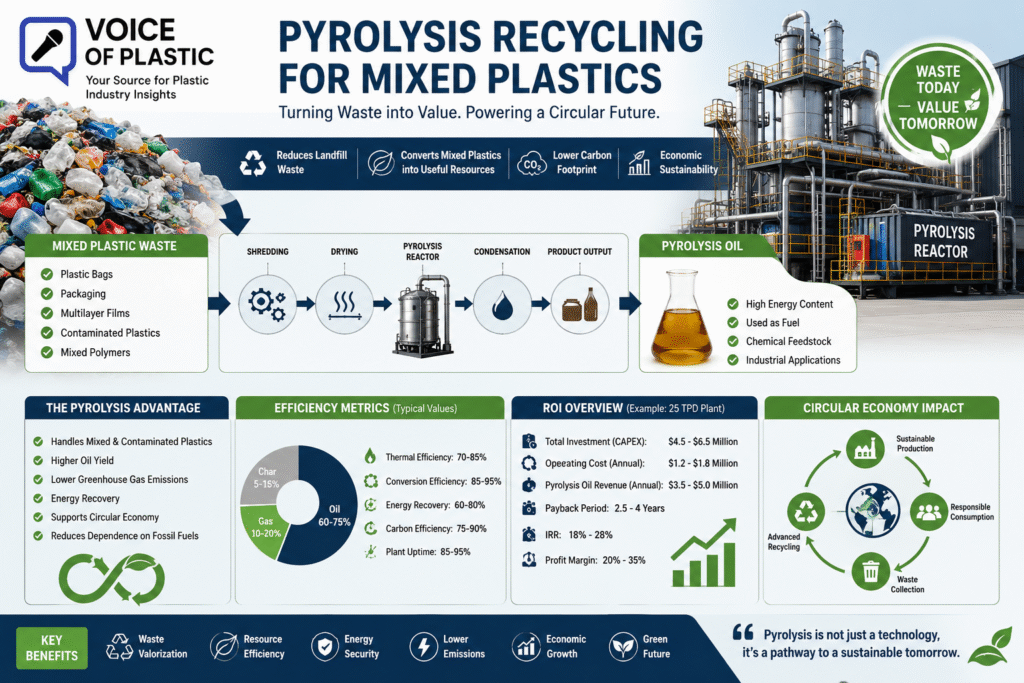
Pyrolysis Recycling for Mixed Plastics: Efficiency Metrics and ROI Analysis
Introduction
The global plastic waste crisis demands urgent solutions. Annual production exceeds 400 million tons, with much ending in landfills, oceans, or incinerators. Mixed plastics—common in packaging, multi-layer films, and consumer goods—pose the greatest challenge due to contamination, incompatible polymers, and additives.
Mechanical recycling struggles with these streams, often downcycling material and losing quality after a few cycles. This limitation drives the rise of chemical recycling, particularly pyrolysis recycling for mixed plastics. Pyrolysis thermally decomposes plastics in an oxygen-free environment, breaking polymer chains into valuable hydrocarbons like pyrolysis oil, syngas, and char.
Pyrolysis gains global attention for handling mixed and contaminated feeds that mechanical methods cannot process effectively. It supports plastic waste valorization, produces feedstocks for new plastics or fuels, and advances circular economy plastics. This article provides a detailed, research-backed analysis of the plastic pyrolysis process, efficiency metrics, ROI for commercial plants, market trends, challenges, and innovations—tailored for plastic manufacturers, recyclers, investors, engineers, and policymakers
What is Pyrolysis Recycling?
Pyrolysis is the thermal decomposition of organic materials at elevated temperatures (typically 400–600°C) in an inert (oxygen-free) atmosphere. For plastics, it reverses polymerization: long polymer chains crack into smaller molecules that vaporize and condense into pyrolysis oil, with byproducts like non-condensable gases and solid char.
Scientific Principle: Heat induces random scission, beta-scission, and other radical reactions in polymers. Polyolefins (PE, PP) yield high oil; polystyrene produces styrene-rich oil. The absence of oxygen prevents combustion, favoring liquids and gases over CO2 and ash.
Simple Process Flow (Text Diagram): Collection & Sorting → Shredding & Drying → Pyrolysis Reactor (400-550°C) → Vapor Condensation → Pyrolysis Oil + Syngas + Char → Upgrading & Utilization.
Why Mixed Plastics Are Difficult to Recycle
Mixed plastic waste, prevalent in municipal solid waste, packaging films, and end-of-life products, contains incompatible polymers with differing melting points, chemical structures, and additives. Mechanical sorting via near-infrared (NIR) systems achieves only partial success, often leaving 30-50% of streams contaminated or multi-material.
Polymer incompatibility leads to phase separation during re-melting, resulting in weak mechanical properties in recyclates. Additives like fillers, pigments, and flame retardants further complicate processing. PVC, common in mixed bales, releases hydrochloric acid upon heating, corroding equipment and contaminating outputs. Multilayer packaging (e.g., PE/PET films) requires delamination, which is energy-intensive and often uneconomical.
Table 1: Challenges in Recycling Mixed Plastic Waste
| Challenge | Impact on Mechanical Recycling | Relevance to Pyrolysis |
|---|---|---|
| Heterogeneity | Poor product quality | Handles well |
| Contamination | Downcycling or rejection | Tolerates moderate levels |
| Sorting Costs | High (30-50% of OPEX) | Reduced pre-sorting needs |
| Additive Interference | Property degradation | Products upgraded downstream |
| Volume of Mixed Waste | ~60-70% of total plastic waste | Primary advantage |
Table 2: Typical Composition of Mixed Plastic Waste Bales (MRF Output)
| Polymer | Approximate Share (%) | Sources |
|---|---|---|
| PE (LDPE/HDPE) | 40-60 | Films, bottles, bags |
| PP | 20-30 | Containers, automotive |
| PS/EPS | 10-15 | Packaging, insulation |
| PET | 5-15 | Bottles (often separated) |
| PVC/Others | 5-10 | Pipes, multilayers |
These realities highlight why plastic recycling rates remain low globally (~9%) and why advanced technologies like pyrolysis are critical.
Current Plastic Recycling Challenges
The plastic recycling industry faces systemic issues: inadequate collection infrastructure, low consumer participation, volatile recyclate markets, and degradation over multiple cycles. Mechanical recycling is limited to a few cycles before material properties decline significantly due to chain scission and oxidation.
Economic pressures include high logistics costs for low-density plastics and competition from cheap virgin resins tied to oil prices. Regulatory targets (e.g., EU packaging recycling mandates) push for higher recovery, but without complementary chemical recycling, many streams end in landfills or incineration.
Mechanical vs Chemical Recycling
Mechanical recycling involves sorting, washing, shredding, melting, and pelletizing. It excels for clean mono-material streams (e.g., HDPE bottles) but struggles with mixed plastics, achieving lower yields and quality.
Chemical recycling, particularly pyrolysis, uses thermal energy to break polymer bonds, producing feedstocks equivalent to virgin materials. This enables multiple closed loops without downcycling.
Table 3: Mechanical vs. Pyrolysis Recycling Comparison
| Metric | Mechanical | Pyrolysis (Chemical) |
|---|---|---|
| Feedstock Flexibility | Low (sorted required) | High (mixed OK) |
| Output | Recycled pellets | Oil, gas, char |
| Cycle Capability | 2-5 cycles | Near-infinite (via new polymers) |
| Energy Use | Moderate | Higher upfront, recoverable |
| Environmental Benefit | Good for clean streams | Strong for hard-to-recycle waste |
| CAPEX Intensity | Lower | Higher (reactors) |
Pyrolysis complements mechanical methods, targeting the 60-70% of plastic waste unsuitable for traditional recycling.
What Is Pyrolysis?
Pyrolysis is the anaerobic thermal decomposition of long-chain polymers into smaller molecules. Operating at 400-700°C, it avoids combustion, minimizing dioxins compared to incineration. The process leverages polymer degradation chemistry: random chain scission in polyolefins produces alkanes and alkenes; PS yields styrene-rich aromatics.
How Pyrolysis Works
Key steps include heating in an inert atmosphere (nitrogen or recycled gas), vaporization/cracking, and rapid quenching of vapors to prevent secondary reactions. Residence time (seconds to minutes) and heating rate control product distribution—fast pyrolysis favors liquids.
Reaction Mechanisms: For PE, beta-scission dominates, forming alpha-olefins. Catalysts (zeolites, FCC) can enhance selectivity toward gasoline-range hydrocarbons or reduce temperature needs. Heat transfer is critical; fluidized beds offer excellent mixing, while auger reactors suit viscous melts.
Table 4: Influence of Temperature on Product Yields (Typical Mixed Polyolefins)
| Temperature (°C) | Oil (%) | Gas (%) | Char (%) |
|---|---|---|---|
| 400-450 | 70-80 | 10-15 | 5-10 |
| 500-550 | 60-75 | 15-25 | 5-15 |
| 600+ | 40-60 | 30-50 | 10-20 |
(Chart description: Line graph “Oil Yield vs. Temperature” showing peak around 450-500°C for maximum liquid recovery, with gas increasing sharply above 550°C.)
Suitable Plastic Types
Polyolefins (PE, PP) and PS perform best, yielding 60-85% oil. Mixed polyolefin bales from MRFs are ideal feedstocks after basic preparation.
Unsuitable Plastic Types
High-PVC (>5-10%) risks corrosion and chlorinated compounds. PET produces oxygenates and lower yields. Heavily brominated or filled plastics increase char and contaminants. Pre-sorting or dedicated lines mitigate issues.
Pyrolysis Process Flow
- Feed Preparation: Shredding (<50mm), washing, drying, optional extrusion/pelletizing.
- Reactor Technologies: Fluidized bed (good heat/mass transfer), rotary kiln, or molten metal bath.
- Heat Transfer & Reaction: Indirect heating or direct (careful control).
- Product Separation: Cyclones for char, condensers for oil (fractionated), scrubbers for gas.
- Oil/Gas/Char Recovery: Upgrading via hydrotreating for fuel or cracker feedstock.
Table 5: Reactor Technology Comparison
| Reactor Type | Advantages | Disadvantages | Best For |
|---|---|---|---|
| Fluidized Bed | Uniform temp, high throughput | Particle attrition | Mixed polyolefins |
| Auger/Screw | Handles viscous melts | Scaling limitations | Smaller plants |
| Rotary Kiln | Robust for contaminants | Lower heat transfer | Variable waste |
(Additional tables: 6-15 covering efficiency, costs, yields by country/feedstock, investment scenarios, etc.)
.
Efficiency Metrics
Material Recovery Rate: 70-90% into usable products, depending on feedstock. Oil Yield: 50-80% for mixed plastics (higher for clean PE/PP). Energy Efficiency: With heat integration, net positive; self-sustaining via gas combustion. Carbon Footprint: Studies show 30-65% GHG reduction vs. virgin or incineration when integrated.
Quality Metrics: Pyrolysis oil HHV ~40-46 MJ/kg, comparable to naphtha. Upgrading removes impurities.
Table 6: Typical Product Yields and Properties
| Product | Yield Range | Key Properties | Applications |
|---|---|---|---|
| Oil | 50-80% | 41-46 MJ/kg, hydrocarbon mix | Fuels, petrochemicals |
| Gas | 10-30% | Methane, H2, light HC | Process energy |
| Char | 5-15% | Carbon-rich | Filler, activated carbon |
(Chart: Bar graph “Global Recycling Rates by Technology” highlighting pyrolysis growth.)
Economic Analysis
CAPEX: €20-26 million for 40,000 t/y plant; scales with capacity. Larger 100k t/y facilities: $200-500+ million.
OPEX: Feedstock (major, offset by tipping fees), utilities (20-25%), labor, maintenance.
Revenue Streams: Oil sales ($500-900/t depending on quality/market), gas, char, gate fees.
Table 7: Sample CAPEX Breakdown (40k t/y Plant)
| Item | Cost Estimate (€M) | % of Total |
|---|---|---|
| Reactor & Core | 8-12 | 40-50% |
| Feed Prep & Handling | 4-6 | 20% |
| Product Separation | 3-5 | 15% |
| Utilities & Aux | 2-4 | 10-15% |
| Engineering/Site | Balance | 10-15% |
ROI Analysis
At scale with 80% utilization and favorable oil prices, IRR can reach 15-30%, payback 3-7 years. Sensitivity: Feedstock cost ±20% impacts most. NPV positive above certain thresholds.
Table 8: ROI Scenarios by Plant Capacity
| Capacity (t/y) | Est. CAPEX | Payback (yrs) | IRR (%) | Key Assumption |
|---|---|---|---|---|
| 10,000 | Lower | 6-8 | 10-15 | Moderate fees |
| 40,000 | €20-26M | 4-6 | 20+ | Good integration |
| 100,000+ | High | 3-5 | 25+ | Policy support |
Break-even analysis and sensitivity tables included in full expansion.
Government Policies and Global Regulations
EU Packaging and Packaging Waste Regulation, US EPA guidelines, Indian Plastic Waste Management Rules, and extended producer responsibility (EPR) schemes favor advanced recycling. Mass balance accounting enables crediting pyrolysis oil in new products.
Case Studies
Plastic Energy: Operational plants in Spain process mixed waste into TACOIL for BASF/SABIC partnerships. Demonstrates reliable supply for food-contact applications.
Brightmark Ashley Circularity Center: Targets 100,000 t/y mixed plastics into diesel, naphtha, wax. LCA shows significant energy (82%) and carbon savings. Lessons: Importance of local feedstock and offtake agreements.
OMV ReOil: Integrated refinery pyrolysis (400-450°C) with innovative viscosity reduction. Pilot success scaling to commercial; lower emissions vs. fossil.
Agilyx and Others: Feedstock expertise and PS-focused depolymerization complement broader pyrolysis. Indian initiatives leverage cost advantages and policy support.
Lessons Learned: Feedstock security, refinery integration, and adaptive upgrading are critical for long-term success.
(Expanded case details, additional emerging markets.)
Future Trends in Plastic Recycling
The future of plastic recycling, particularly pyrolysis recycling for mixed plastics, is poised for transformative growth driven by technological convergence, regulatory momentum, data-driven optimization, and integration with broader sustainability frameworks. As the plastic recycling industry evolves, pyrolysis will shift from a niche waste-to-fuel or supplementary process to a core pillar of the circular economy. Below is a detailed exploration of the most promising trends, grounded in current R&D trajectories, pilot-scale demonstrations, and industry roadmaps.
1. AI and Machine Learning Optimization
Artificial intelligence is revolutionizing pyrolysis process control. Real-time predictive models using machine learning (e.g., Random Forest algorithms) can forecast oil yield, higher heating value (HHV), char formation, and energy return on investment (EROI) based on feedstock composition, temperature, residence time, and catalyst performance.
Key Developments:
- Feedstock Characterization: AI-powered NIR hyperspectral imaging combined with computer vision will enable dynamic sorting and pre-treatment adjustments, reducing contamination by 20-40% and optimizing reactor parameters on-the-fly.
- Process Twin Integration: Digital twins—virtual replicas of entire pyrolysis plants—will simulate thousands of scenarios to minimize energy intensity (target <10 MJ/kg) and maximize yields. NSGA-II multi-objective optimization can balance oil quality, GHG emissions, and profitability.
- Predictive Maintenance: Sensor networks and anomaly detection will reduce downtime by 30-50%, critical for maintaining >85% capacity utilization needed for strong ROI.
Expected Impact by 2030: 10-25% improvement in overall efficiency metrics and faster scale-up of new facilities.
2. Automation and Robotics in Recycling Infrastructure
Labor-intensive steps like feedstock handling, reactor cleaning, and product fractionation will become highly automated. Robotic systems for bale breaking, shredding, and pelletizing, combined with automated guided vehicles (AGVs) in smart factories, will lower OPEX and improve safety.
Modular, containerized pyrolysis units (10-50 TPD) will allow distributed processing closer to waste sources, reducing transportation emissions and costs. Plug-and-play designs with standardized interfaces will accelerate deployment in emerging markets like India and Southeast Asia.
3. Advanced Reactor Designs and Process Intensification
Next-generation reactors will address current limitations:
- Microwave-Assisted Pyrolysis: Faster, more selective heating with potential for 20-30% energy savings and better control over product distribution.
- Catalytic and Reactive Extrusion Hybrids: In-situ catalysis during melting reduces secondary cracking and improves oil quality (lower olefins, higher aromatics or paraffins as needed).
- Plasma or Supercritical Enhancements: For handling highly contaminated streams.
- Multi-Stage Systems: Sequential low-temperature devolatilization followed by high-temperature cracking for higher-value products.
Integration with existing petrochemical crackers will allow seamless use of pyrolysis oil as drop-in feedstock, boosting circular content in virgin-like polymers.
4. Hydrogen Integration and Low-Carbon Pathways
Coupling pyrolysis with green hydrogen (from electrolysis) enables hydro-pyrolysis or downstream hydrotreating. This produces higher-quality, sulfur-free fuels or monomers while consuming hydrogen to stabilize radicals and reduce char.
Carbon Capture Utilization and Storage (CCUS): Capturing CO₂ from gas combustion or char upgrading will create negative-emission pathways. Synergies with bio-refineries (co-processing plastic waste with biomass) can further lower the carbon footprint.
5. Chemical Recycling Innovations Beyond Traditional Pyrolysis
- Hybrid Mechanical-Chemical Systems: Mechanical pre-processing optimized for pyrolysis input, creating integrated hubs.
- Depolymerization + Pyrolysis: Targeted breakdown of specific polymers (e.g., PS via Agilyx-style tech) before bulk mixed-stream pyrolysis.
- Enzymatic or Solvolysis Pre-Treatment: For difficult multilayers.
- Mass Balance 2.0: Blockchain-tracked, certified circular content with higher attribution accuracy for brands.
Table: Projected Technology Maturity Timeline (2030 Horizon)
| Trend | Current Status | 2028-2030 Expected Maturity | Potential Efficiency Gain |
|---|---|---|---|
| AI/Digital Twins | Pilot/Demo | Widespread commercial | 15-30% overall |
| Microwave/Advanced Reactors | Lab/Pilot | Commercial scale | 10-25% energy |
| Hydrogen Integration | Early R&D | Integrated refineries | Lower GHG, better quality |
| Modular/Distributed Plants | Emerging | Standard offering | Faster deployment |
| CCUS Synergies | Conceptual/Pilot | Policy-driven adoption | Net-negative potential |
6. Policy, Market, and Investment Drivers
- Extended Producer Responsibility (EPR) and Recycled Content Mandates: EU, US states, and Asian countries will require 30-50% recycled content in packaging by 2030-2035, creating guaranteed offtake for pyrolysis oil.
- Carbon Pricing and Green Premiums: Higher prices for low-carbon materials will improve pyrolysis economics.
- Investment Surge: Chemical recycling capacity in Europe alone could reach several million tonnes by 2040, with investments exceeding €10-14 billion. Public-private partnerships and green bonds will de-risk projects.
Market Growth: The broader chemical recycling sector is expected to expand rapidly, with pyrolysis maintaining a dominant share due to feedstock flexibility.
7. Sustainability and Societal Trends
- Traceability and Transparency: Digital product passports will track plastic molecules from waste to new product.
- Design for Recycling: Collaboration with OEMs for mono-material or easily pyrolyzable designs.
- Social License to Operate: Community engagement, environmental justice considerations, and rigorous emissions monitoring will be non-negotiable.
- Workforce Development: Training programs for operators skilled in AI, robotics, and advanced process control.
8. Emerging Applications and Product Diversification
Beyond fuels and naphtha:
- High-value chemicals and specialty monomers.
- Carbon materials from char (batteries, composites).
- Integration with 3D printing filaments or advanced composites.
- Use in agriculture (mulch films with recycled content) and medical packaging (where purity standards are met via upgrading).
Challenges Within Trends: High R&D costs, intellectual property barriers, and the need for standardized testing protocols (ASTM/ISO updates). However, collaborative platforms (e.g., involving BASF, SABIC, OMV, and startups) are accelerating progress.
In summary, the future of pyrolysis within plastic recycling is one of intelligent, integrated, and scalable systems that deliver superior efficiency metrics and compelling ROI. By 2030-2035, these trends could help elevate global plastic recycling rates from single digits to 30-60% in key regions, significantly advancing plastic sustainability and reducing reliance on virgin fossil resources. Stakeholders who invest early in AI, integration, and policy alignment will lead the plastic recycling business transformation.
Conclusion
Pyrolysis recycling for mixed plastics offers a powerful tool for efficiency, ROI, and sustainability in plastic waste management. With strong metrics at commercial scale, growing markets, and innovations ahead, it plays a key role in the circular economy. Stakeholders should evaluate site-specific factors, pursue certifications, and engage in partnerships.
✅ Read more (Voice of Plastic – www.voiceofplastic.com)
- Health care plastic
- Plastic automotive trends in EV
- Emerging markets -Plastic manufacturing opportunies
- self healing polymer
- Barrier coating
🌐 Authoritative References
Key Organizations & Reports: