Will Oil Wars Trigger a Massive Shift in Recycling & Bio-Plastics Adoption?
Introduction
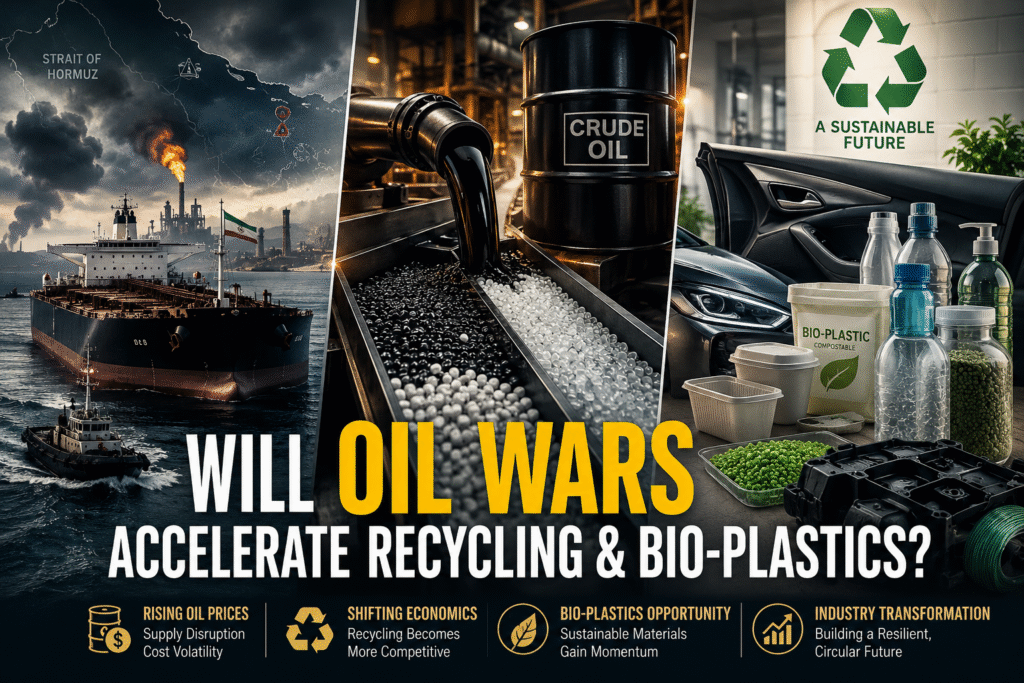
In early 2026, escalating conflicts in the Middle East, including disruptions in the Strait of Hormuz, sent Brent crude prices surging above $90–$105 per barrel. Tanker traffic plummeted, supply chains strained, and polymer manufacturers faced immediate cost pressures.
For an industry where virgin resins derive primarily from petrochemical feedstocks like naphtha and ethylene, these spikes are more than a headline. They represent a fundamental shift in economics. The oil wars impact on recycling and bioplastics is now a critical question for plastic engineers, OEMs, sustainability managers, and procurement teams.
Historically, low oil prices favored virgin materials. Today, volatility from oil wars impact on recycling and bioplastics geopolitical tensions in plastics industry is forcing a reevaluation. Could sustained high or unpredictable crude oil prices finally tip the scales toward post-consumer recycled (PCR) plastics, mechanical and chemical recycling, and bio-based alternatives like PLA and PHA?
This in-depth analysis examines the mechanics, opportunities, and barriers shaping the polymer supply chain disruption in an era of heightened geopolitical risk oil wars impact on recycling and bioplastics.
Table of Contents
- What Are Oil Wars and Why Do Geopolitical Tensions Affect Polymers?
- How Crude Oil Prices Influence Virgin Plastic Resin Economics
- Can Oil Wars Make Recycling More Economically Attractive?
- Will Bio-Plastics Adoption Accelerate?
- Automotive, Packaging, and FMCG Sector Impacts
- Challenges Preventing Rapid Transition
- Future Outlook for Polymer Manufacturers and OEMs
- Expert Opinion and Market Outlook
- Conclusion
What Are Oil Wars and Why Do Geopolitical Tensions Affect Polymers?
“Oil wars” refer to conflicts or escalations that disrupt global crude supply, particularly in chokepoints like the Strait of Hormuz, which handles roughly 20–25% of seaborne oil trade.
Recent 2026 events—strikes, blockades, and attacks on tankers—have demonstrated how quickly these tensions translate into polymer supply chain disruption. Geopolitical risk premiums drive oil prices higher through two channels: actual or threatened supply shortages (risk channel) and broader economic uncertainty that eventually dampens demand (activity channel).
Plastics are inextricably linked to crude oil and plastics market dynamics. Over 90% of polymers like polyethylene (PE), polypropylene (PP), and PET start as fossil feedstocks. Naphtha, a key cracking input, accounts for 70–90% of many resin production costs. A $10/barrel sustained increase can lift resin prices 5–10% within weeks.ecpeuropa
Oil wars impact on recycling and bioplastics-Geopolitical impact on plastics industry manifests as:
- Price volatility in virgin resin cost fluctuations
- Logistics disruptions raising freight and import costs
- Strategic hedging by manufacturers seeking alternatives
- Policy acceleration toward circular economy plastics in import-dependent regions
This creates a window where oil wars impact on recycling and bioplastics economics in plastics and bio-plastics adoption trends become more compelling.
How Crude Oil Prices Influence Virgin Plastic Resin Economics
The relationship is direct and well-documented. Crude oil serves as the primary feedstock via steam cracking into ethylene, propylene, and other monomers.
When Brent crude rises due to geopolitical events, resin pricing trends follow with a lag of days to weeks, depending on inventory levels and contract structures. In 2026 scenarios, elevated prices have already tightened margins for converters reliant on virgin material.
Key effects include:
- Feedstock cost pass-through: Producers adjust monomer and polymer prices upward.
- Inventory strategies: Buyers build stocks during dips, amplifying swings.
- Regional disparities: Europe and Asia, heavily reliant on Middle East imports, feel sharper pain than North America with domestic shale advantages.
- Downstream pressure: Automotive suppliers and packaging converters face margin compression, prompting procurement teams to explore alternatives.-spe
Sustained oil price impact on polymer industry above $80–90/barrel narrows the gap with recycled resins, altering long-standing economics.
Can Oil Wars Make Recycling More Economically Attractive?
Yes, particularly when virgin resin costs rise faster than collection and processing expenses.
The oil wars impact on recycling and bioplastics is most evident here. High crude prices improve the relative competitiveness of post-consumer recycled (PCR) materials.
Mechanical Recycling
Mechanical recycling remains the most mature route. It involves sorting, shredding, washing, and pelletizing. When virgin PE or PP exceeds certain thresholds, r-PE and r-PP become viable drop-in replacements for non-food contact applications.
Chemical Recycling
Advanced (chemical) recycling breaks polymers back to monomers or feedstocks via pyrolysis, depolymerization, or gasification. This handles mixed or contaminated streams that mechanical processes cannot. Geopolitical supply risks make domestic waste-derived feedstocks strategically valuable, reducing exposure to international crude oil and plastics market volatility.
oil wars impact on recycling and bioplastics Resin Demand Trends
- PCR uptake: Automotive and packaging brands report increased specifications for 30–50% recycled content when price parity improves.
- Infrastructure gaps: Collection rates, sorting technology, and traceability remain bottlenecks, but high virgin prices incentivize investment in plastic recycling infrastructure.
- Economics: The spread between virgin and recycled narrows or reverses during spikes, improving recycling economics in plastics.
Practical example: A European automotive Tier 1 supplier shifted 15% of interior components to PCR-PP during 2022 volatility and is accelerating similar moves in 2026.
Will oil wars impact on recycling and bioplastics Adoption Accelerate?
Bio-plastics adoption trends gain momentum under sustained high oil prices, though structural limitations persist.
Key Materials
- PLA (Polylactic Acid): Fermented from corn or sugarcane. Strong in rigid packaging and fibers. Growing capacity but sensitive to agricultural feedstock prices.
- PHA (Polyhydroxyalkanoates): Bacterial fermentation. Excellent biodegradability and marine compatibility. Higher cost but expanding in premium applications.
- Bio-based PE: Drop-in solution from sugarcane ethanol. Chemically identical to fossil PE, fully recyclable in existing streams.
- Compostable Plastics: PBAT blends for films and bags.
Sustainable polymers benefit from both cost pressure on virgins and regulatory tailwinds (extended producer responsibility, single-use bans). Global bio-based capacity is projected to expand significantly toward 2030, with packaging leading demand.
Industrial Applications
- Packaging: Flexible films, bottles, trays.
- Automotive: Interior parts, lightweight composites.
- Agriculture: Mulch films.
- Consumer Goods: Durable and single-use items.
Limitations and Costs
Bio-plastics often carry 20–50%+ premiums. Land use competition, performance gaps in some applications (heat resistance, barrier properties), and end-of-life infrastructure challenges slow full replacement. Drop-in solutions like bio-PE face fewer hurdles than novel biodegradable types.
The sustainable material transition accelerates most where brands have aggressive ESG targets or where oil price impact on polymer industry justifies the switch.
Automotive, Packaging, and FMCG Impact
Automotive Suppliers: Lightweighting with plastics is critical for EV efficiency. High virgin costs and supply risks push adoption of PCR and bio-based materials in non-structural parts. OEMs like those following EU sustainability mandates are specifying higher recycled content.
Packaging Professionals: FMCG brands face consumer and regulatory pressure. Volatile resin pricing trends encourage lightweighting, design for recyclability, and bio-based alternatives. A major beverage company expanding bio-PET capacity illustrates the trend.
Procurement Teams: Diversifying suppliers and signing long-term recycled content agreements becomes risk management, not just sustainability.
These sectors drive demand signals that influence upstream polymer manufacturers.
Challenges Preventing Rapid Transition
Despite favorable economics in high-oil scenarios, barriers remain:
- Infrastructure: Inadequate collection, sorting, and advanced recycling capacity.
- Performance Consistency: Recycled materials can vary in properties; bio-plastics may underperform in demanding uses.
- Capital Investment: Scaling chemical recycling or bio-production requires billions.
- Policy Fragmentation: Differing global regulations create complexity.
- Cost and Scale: Bio-plastics production volumes are still small relative to fossil-based (millions vs. hundreds of millions of tonnes).
- Supply Chain Inertia: Long qualification cycles for automotive and medical applications.
Polymer supply chain disruption from oil wars impact on recycling and bioplastics geopolitics highlights these weaknesses but does not instantly resolve them.
Future Outlook for Polymer Manufacturers and OEMs
Polymer manufacturers should:
- Invest in hybrid portfolios combining virgin, recycled, and bio-based.
- Develop traceability and certification systems.
- Form partnerships across the value chain for closed-loop systems.
OEMs and processors: Model scenarios with $80–120 oil, prioritize design for circularity, and build resilient supplier networks.
The circular economy plastics model gains strategic importance as a hedge against volatility.
Expert Opinion and Market Outlook
As a senior polymer industry analyst, the current environment represents a structural opportunity rather than a temporary blip. While oil prices may moderate, repeated geopolitical shocks are likely. The oil wars impact on recycling and bioplastics will compound with regulations and consumer demands.
Expect accelerated investment in recycling infrastructure and selective bio-plastics scale-up, particularly drop-ins. Full transition remains decades-long, but 2026–2030 will mark a decisive acceleration in sustainable polymers adoption for competitive advantage.
Conclusion
The oil wars impact on recycling and bioplastics is multifaceted: it raises virgin resin costs, improves recycling economics, and spotlights bio-based alternatives as strategic options. While not a complete solution to all challenges, geopolitical tensions in plastics industry are catalyzing the sustainable material transition faster than policy alone could achieve.
Forward-looking companies that act now—through material innovation, supply chain redesign, and circular investments—will emerge more resilient. The polymer industry stands at an inflection point where risk and opportunity converge.
Also read –
From Oil Shock to Polymer Crisis-2026
FAQs
Q1: How do oil wars directly affect plastic production costs? Rising crude prices increase naphtha and monomer costs, directly elevating virgin resin prices and pressuring margins across the supply chain.
Q2: Does high oil price make recycled plastics cheaper than virgin? Not always cheaper outright, but it narrows the gap significantly, making PCR and recycled resins more competitive, especially in non-critical applications.
Q3: Which bio-plastics benefit most from oil price volatility? Drop-in solutions like bio-PE and bio-PP, plus cost-competitive options like PLA for packaging, see faster evaluation and potential adoption.
Q4: What role does the Strait of Hormuz play in polymer markets? Disruptions here spike global oil prices, affecting feedstock costs for a large share of global plastics production.
Q5: Are there limitations to rapid recycling scale-up? Yes—collection rates, contamination, advanced recycling capacity, and consistent quality remain key hurdles despite improved economics.
Q6: How should procurement teams respond to resin pricing trends? Diversify sources, secure long-term recycled content contracts, qualify alternative materials, and incorporate geopolitical risk into forecasting.