why Plastic in automotive is important ?
Current Market Overview
Production and Domestic Sales (FY26, April 2025–March 2026):
- Total domestic sales: Record ~28.27 million units (up 10.4% YoY), the highest in years.
- Two-Wheelers (2W): Dominant segment at ~21.71 million units (up 10.7% YoY). Motorcycles lead, with scooters gaining in urban areas.
- Passenger Vehicles (PV): ~4.64 million units (up 7.9% YoY). Strong SUV/Utility Vehicle (UV) demand; UVs now hold ~66% share within PVs. Hatchbacks and sedans face pressure from premiumization.
- Commercial Vehicles (CV): ~1.08 million units (up 12.6% YoY), supported by infrastructure push.
- Three-Wheelers: ~0.84 million units (up 12.8% YoY).
- Total production: ~34.71 million units (up ~11.8% YoY).
Market Structure and Shares:
- By Vehicle Type: 2W ~77% of total market volume historically, PVs ~16%. Premiumization trend: Shift toward SUVs, feature-rich models, and higher price points.
- Key Players (PV segment, approximate recent shares):
- Maruti Suzuki: ~40-44% (mass-market leader, strong in exports too).
- Hyundai: ~10-14%.
- Tata Motors & Mahindra: ~12-13% each (strong in SUVs/EVs).
- Others: Toyota, Kia, etc.
- 2W Leaders: Hero MotoCorp, Honda, TVS, Bajaj.
Exports: Strong growth. FY25 saw >5.3 million units exported (up 19%). FY26 PV exports continued momentum (e.g., Maruti leading). Key markets: Africa, Latin America, Middle East, Europe. India positions as a cost-competitive hub.
EV Penetration: Growing but still early. ~5-8% overall in recent periods (higher in 2W/3W). Government targets 30% EV sales by 2030. EV registrations reached millions, with policy support (FAME, PM E-DRIVE). Three-wheelers and 2W lead electrification; PV EVs lag due to range, charging, and price barriers.
Economic Context: Supported by rising incomes, urbanization, infrastructure (roads, expressways), rural recovery, and a young population. FDI inflows strong (cumulative significant since 2000). Auto components industry ~USD 80 billion turnover.
Key Drivers and Trends
- Premiumization & Aspirational Demand: Consumers upgrading to SUVs, connected features, safety (BNCAP), and better powertrains.
- Rural & Urban Split: Rural demand key for 2W/CV; urban for PVs/scooters/EVs.
- Sustainability: Push for EVs, CNG, hybrids. Policy incentives for batteries, charging infra.
- Manufacturing: “Make in India,” PLI schemes for EVs/ACC batteries. India as R&D and export base.
- Challenges: High vehicle prices, fuel costs, semiconductor/electronics import dependence, charging infrastructure gaps, skill shortages for EVs, and environmental regulations.
EV Future Outlook (2026–2030/2035)
Plastic in automotive EV sector is projected for steady, robust growth, with volume and value expansion driven by economic momentum (India’s GDP growth ~7%+), policy support, and global shifts.
Market Size Projections (varied sources, approximate):
- Overall automotive market: CAGR 6-8.8% through early 2030s. Volume could reach 8+ million PVs or higher total vehicles; value estimates from ~USD 150-200B+ toward 250-300B+ by 2030-32.
- PVs: Toward 6+ million annual sales by 2030.
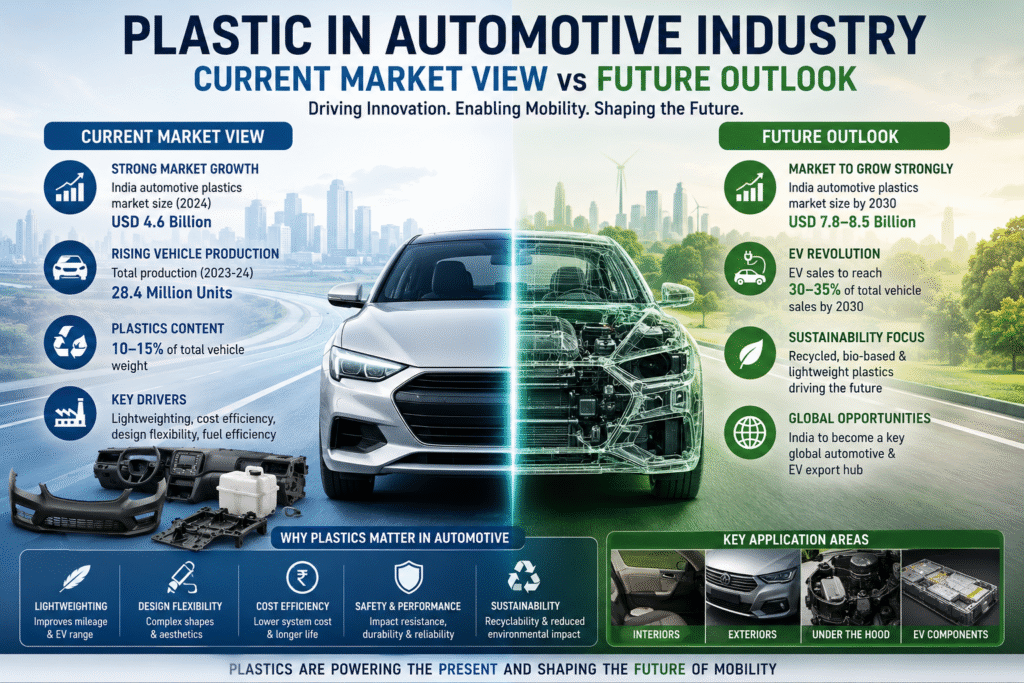
- EVs: Explosive growth (CAGR 30-40%+ for market value). Potential 20-30% penetration by 2030 (government target ambitious; realistic ~15-25% in PVs, higher in 2W/3W). Battery tech, localization, and infra critical
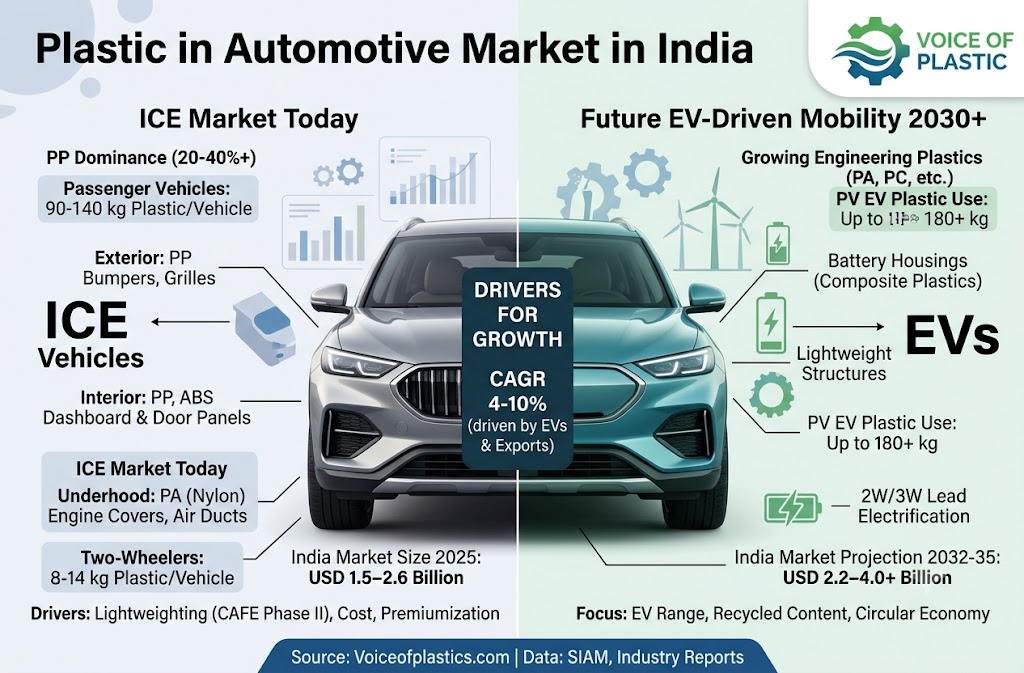
Plastic in automotive play a critical role in the Indian automotive industry by enabling lightweighting, cost reduction, design flexibility, corrosion resistance, and improved fuel efficiency/safety. They typically account for 8–15% of a vehicle’s weight but up to 50% of its volume, replacing heavier metals and supporting regulatory compliance like CAFE (Corporate Average Fuel Efficiency) norms.
Plastic Usage per Vehicle
what percentage of plastic in automotive industries used?
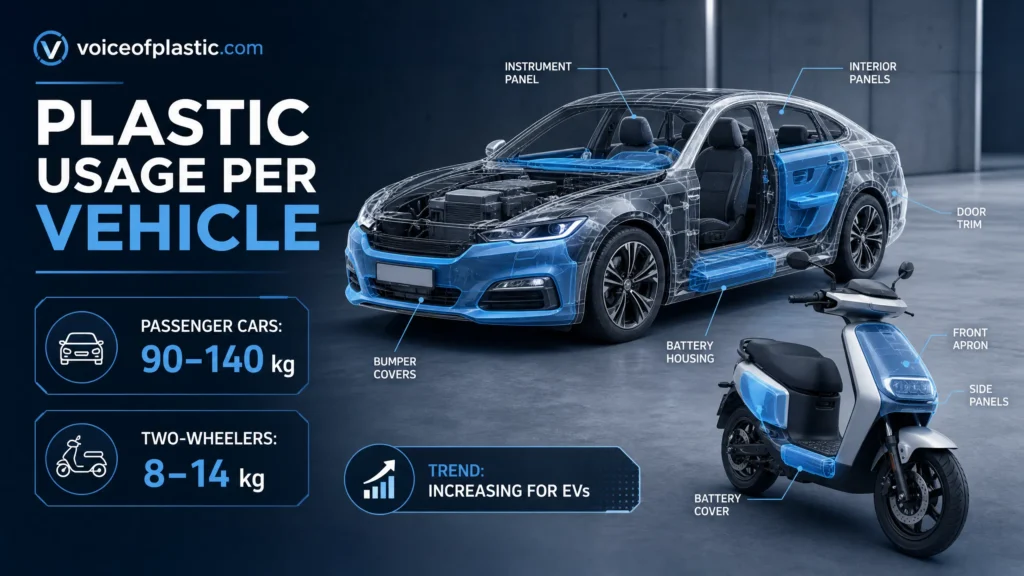
- Passenger Vehicles (PVs/Cars): 90–140 kg of plastic in automotive per vehicle (higher in premium/SUV models due to more features and composites). This is lower than global averages (often 150–200+ kg or ~10–15% of curb weight) but rising with premiumization and EV adoption.
- Two-Wheelers (2Ws): 8–14 kg per vehicle (dominant volume driver due to massive production scale).
- Trend: plastic in automotive content has increased over time (e.g., from ~120 kg in older global models to 180+ kg today in many vehicles) to meet efficiency and emission targets. EVs often use specialized plastics for battery housings, lightweight structures, and high-voltage components.
With FY26 domestic vehicle sales exceeding 28 million units (heavily 2W-driven), annual plastic in automotive consumption in the sector is substantial, supporting the broader auto components industry (~USD 80 billion turnover).
Plastic in Automotive Market Size & Contribution in india 2026
The dedicated plastic in Automotive Market in india (resins, compounds, and components for OEMs) is valued in the range of USD 1.5–2.6 billion in 2025, with variations across reports due to scope (raw materials vs. finished parts).
- Projections:
- To USD 2.2–4.0+ billion by 2032–2035.
- CAGR: 4–10% (conservative estimates ~4–4.4%; higher in some analyses driven by lightweighting).
- Contribution to Auto Sector: Plastics are a key sub-segment of the ~USD 80 billion Indian auto components industry (which contributes ~2.3–7% to GDP and supports millions of jobs). They enable ~10–15% weight reduction benefits, directly aiding fuel efficiency, exports, and EV transition. Tier-1 suppliers (e.g., Motherson, Varroc, Machino Plastics) and resin producers (Reliance for PP) are major players.
Drivers:
- Rising vehicle production & exports.
- CAFE Phase II mandates (adding 8–12 kg plastic per new ICE car for lightweighting).
- EV growth (specialized compounds for batteries, etc.).
- Premiumization (more interior/exterior features).
- “Make in India” and PLI schemes.
Plastic in automotive Market Share by Material Type
Polypropylene (PP) dominates due to its versatility, low cost, chemical resistance, and use in bumpers, dashboards, interior panels, and underbody parts.
- PP: Largest share (~20–40%+ globally/regionally; dominant in India).
- Other Key Materials:
- Polyurethane (PU): Fast-growing for foams, seats, interiors.
- Acrylonitrile Butadiene Styrene (ABS): Interiors, trims, aesthetics.
- Polyamide (PA/Nylon): Under-hood, engine components.
- Polycarbonate (PC): Lighting, glazing, impact-resistant parts.
- PVC, HDPE, and others (PMMA, etc.).
Engineering Plastic in automotive (PA, PC, etc.) command higher value margins (35–40% of market value but higher profit share) despite lower volume.
Plastic in automotive Market Share by Application
- Interior Components: Largest (~25–60%+ share) — dashboards, door panels, seats, trims, flooring.
- Exterior: Bumpers, body panels, mirrors, grilles.
- Under-the-Bonnet/Engine Bay: Air ducts, reservoirs, covers (heat-resistant grades).
- Electrical & Electronics: Wiring, connectors, battery components (growing with EVs).
- Others: Fuel systems, chassis parts.
Plastic in automotive Vehicle Type Split: Conventional ICE vehicles ~65% share; 2Ws and PVs lead demand by volume.
Regional & Competitive Insights
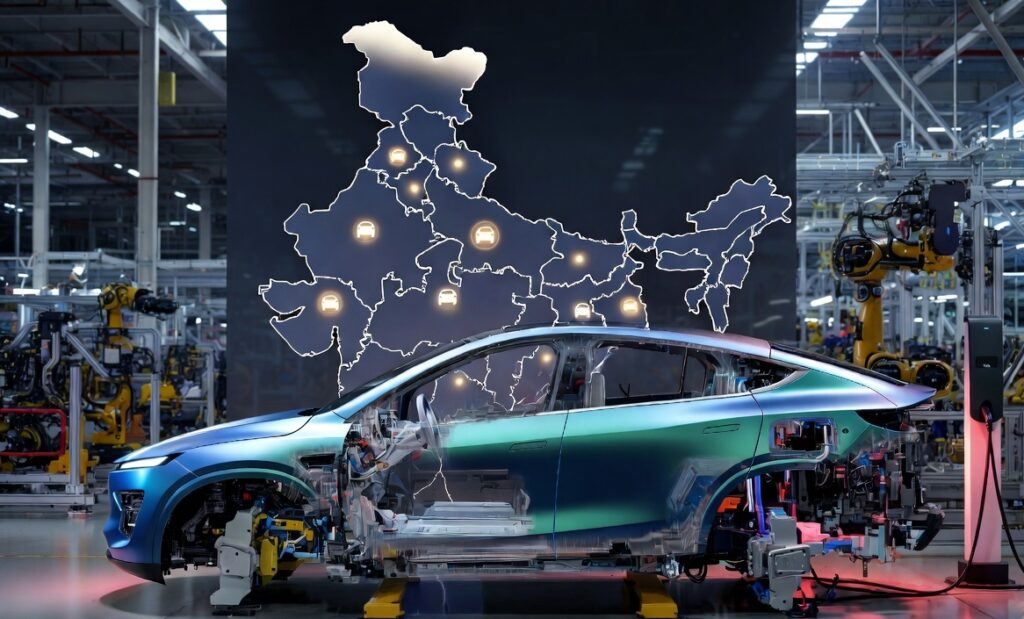
- North India holds significant share (~30%) due to manufacturing clusters.
- Key suppliers: Domestic resin giants (Reliance) + global engineering plastic providers + Tier-1 molders.
- Challenges: Import dependence for some engineering plastics, recycling/sustainability pressure, raw material volatility.
Plastic in automotive Future Outlook
- Growth: Steady expansion aligned with 6–9% auto sector CAGR, faster in EVs and exports. Plastics in automotive content per vehicle expected to rise toward 150–220 kg globally/in premium segments.
- Opportunities: Recycled content, bioplastics, EV-specific materials, lightweight composites. Auto components (including plastics) targeted to reach USD 200 billion by 2030.
- Sustainability: Push for circular economy, recycled Plastics in automotive , and compliance with end-of-life vehicle norms.
- Risks: Supply chain (resins), cost pressures, and competition.